a fair coin is flipped 10 times. it lands facing heads up 2 out of 10 times. the probability of a coin…
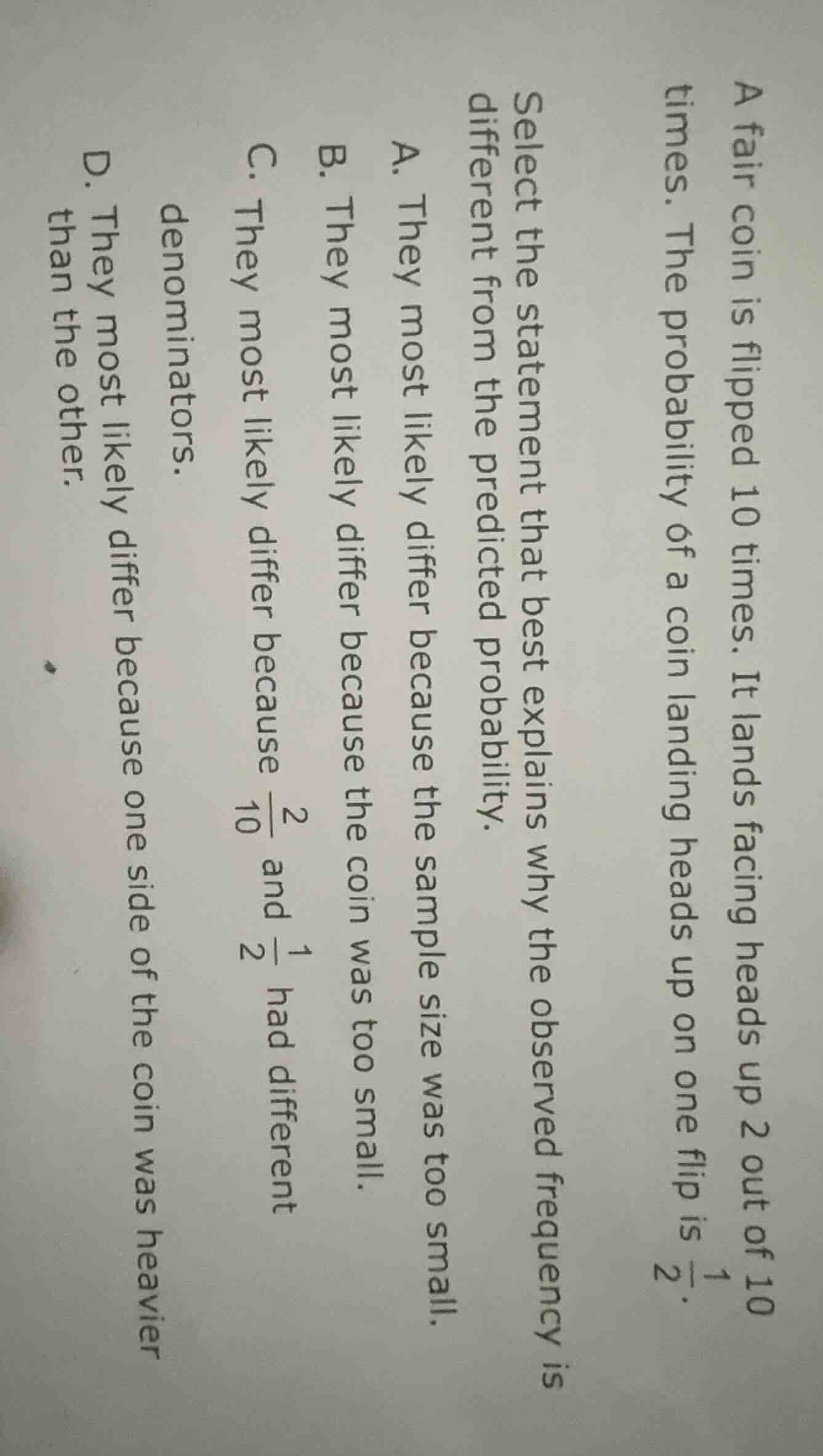
a fair coin is flipped 10 times. it lands facing heads up 2 out of 10 times. the probability of a coin landing heads up on one flip is $\\frac{1}{2}$.\n\nselect the statement that best explains why the observed frequency is different from the predicted probability.\na. they most likely differ because the sample size was too small.\nb. they most likely differ because the coin was too small.\nc. they most likely differ because $\\frac{2}{10}$ and $\\frac{1}{2}$ had different denominators.\nd. they most likely differ because one side of the coin was heavier than the other.
Answer
Explanation:
Step1: Identify theoretical and observed values
The theoretical probability of heads is $P(H) = \frac{1}{2}$, while the observed frequency is $\frac{2}{10} = \frac{1}{5}$.
Step2: Analyze the Law of Large Numbers
The Law of Large Numbers states that observed frequency approaches theoretical probability as sample size increases.
Step3: Evaluate the sample size
A sample size of $n = 10$ is small, making significant deviations from the expected value ($5$ heads) likely due to random chance.
Step4: Select the best explanation
Option A correctly identifies that small sample sizes often result in observed frequencies that differ from theoretical probabilities.
Answer:
A. They most likely differ because the sample size was too small.