with a fair die, the probability of rolling any number 1 through 6 is the same. if $p(1)$ represents the…
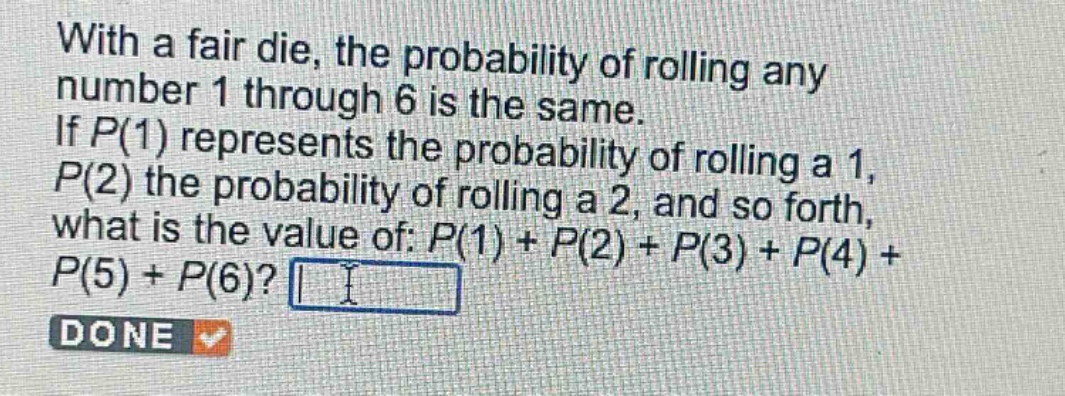
with a fair die, the probability of rolling any number 1 through 6 is the same. if $p(1)$ represents the probability of rolling a 1, $p(2)$ the probability of rolling a 2, and so forth, what is the value of: $p(1)+p(2)+p(3)+p(4)+p(5)+p(6)$?
Answer
Explanation:
Step1: Recall probability formula
For a fair - die, the probability of an event (E) is (P(E)=\frac{\text{Number of favorable outcomes}}{\text{Total number of outcomes}}). The total number of outcomes when rolling a die is (n = 6) (the numbers 1, 2, 3, 4, 5, 6).
Step2: Calculate individual probabilities
For (P(1)), the number of favorable outcomes of rolling a 1 is 1. So (P(1)=\frac{1}{6}). Similarly, (P(2)=\frac{1}{6}), (P(3)=\frac{1}{6}), (P(4)=\frac{1}{6}), (P(5)=\frac{1}{6}), and (P(6)=\frac{1}{6}).
Step3: Calculate the sum
[ \begin{align*} P(1)+P(2)+P(3)+P(4)+P(5)+P(6)&=\frac{1}{6}+\frac{1}{6}+\frac{1}{6}+\frac{1}{6}+\frac{1}{6}+\frac{1}{6}\ &=\frac{1 + 1+1+1+1+1}{6}\ &=\frac{6}{6}\ & = 1 \end{align*} ]
Answer:
1