a family has two children. if b represents a boy and g represents a girl, the set of outcomes for the…
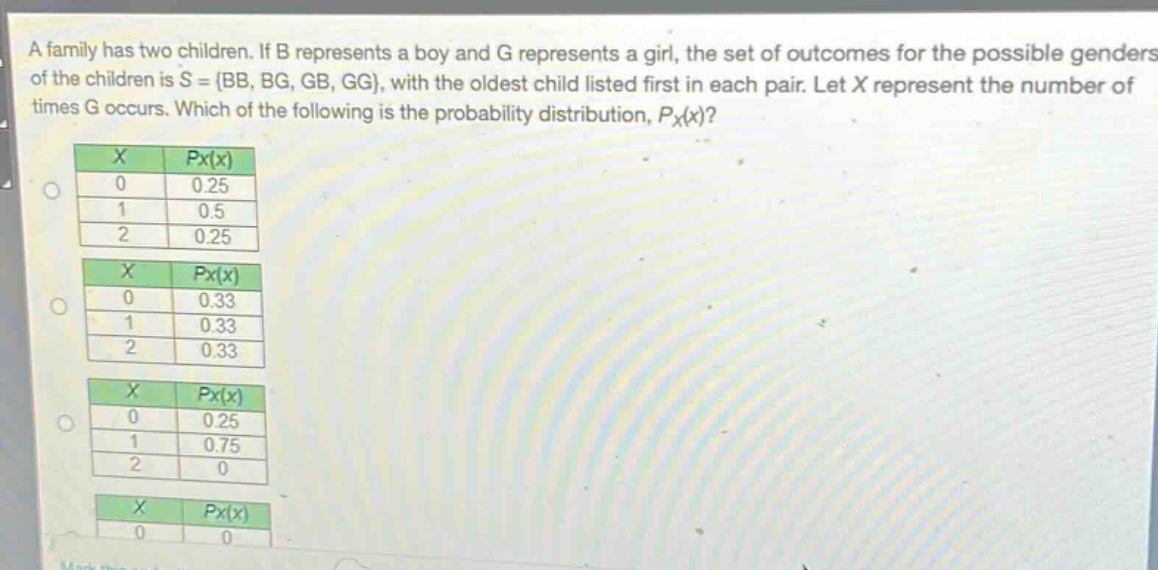
a family has two children. if b represents a boy and g represents a girl, the set of outcomes for the possible genders of the children is s = {bb, bg, gb, gg}, with the oldest child listed first in each pair. let x represent the number of times g occurs. which of the following is the probability distribution, $p_x(x)$?\n|x|px(x)|\n|----|----|\n|0|0.25|\n|1|0.5|\n|2|0.25|\n|x|px(x)|\n|----|----|\n|0|0.33|\n|1|0.33|\n|2|0.33|\n|x|px(x)|\n|----|----|\n|0|0.25|\n|1|0.75|\n|2|0|\n|x|px(x)|\n|----|----|\n|0|0|
Answer
Explanation:
Step1: Calculate total number of outcomes
The sample - space $S={BB, BG, GB, GG}$, so $n(S) = 4$.
Step2: Calculate $P(X = 0)$
The event $X = 0$ (no girls) occurs when the outcome is $BB$. So $n(X = 0)=1$, and $P(X = 0)=\frac{n(X = 0)}{n(S)}=\frac{1}{4}=0.25$.
Step3: Calculate $P(X = 1)$
The event $X = 1$ (one girl) occurs when the outcomes are $BG$ or $GB$. So $n(X = 1)=2$, and $P(X = 1)=\frac{n(X = 1)}{n(S)}=\frac{2}{4}=0.5$.
Step4: Calculate $P(X = 2)$
The event $X = 2$ (two girls) occurs when the outcome is $GG$. So $n(X = 2)=1$, and $P(X = 2)=\frac{n(X = 2)}{n(S)}=\frac{1}{4}=0.25$.
Answer:
| $X$ | $P_X(x)$ |
|---|---|
| $0$ | $0.25$ |
| $1$ | $0.5$ |
| $2$ | $0.25$ |