a farmer wanted to determine if adding an organic fertilizer to his individually potted tomato plants will…
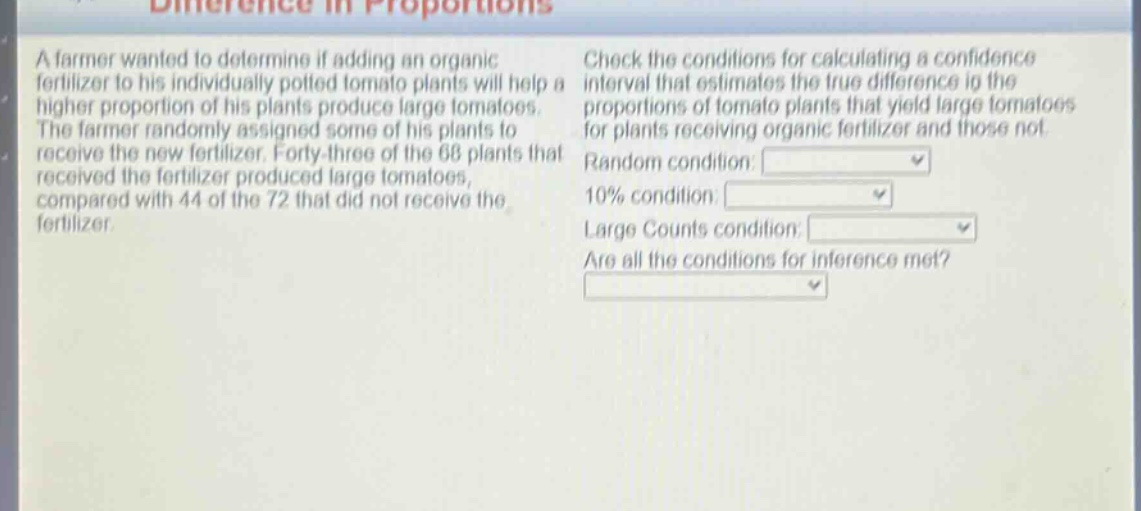
a farmer wanted to determine if adding an organic fertilizer to his individually potted tomato plants will help a higher proportion of his plants produce large tomatoes. the farmer randomly assigned some of his plants to receive the new fertilizer. forty - three of the 68 plants that received the fertilizer produced large tomatoes, compared with 44 of the 72 that did not receive the fertilizer. check the conditions for calculating a confidence interval that estimates the true difference in the proportions of tomato plants that yield large tomatoes for plants receiving organic fertilizer and those not. random condition: 10% condition: large counts condition: are all the conditions for inference met?
Answer
Explanation:
Step1: Analyze Random condition
The farmer randomly assigned plants to receive the fertilizer or not, so the random condition is met.
Step2: Analyze 10% condition
Assume the population of tomato - plants is large enough. Since the samples (68 plants with fertilizer and 72 plants without fertilizer) are likely to be less than 10% of the total population of tomato - plants, the 10% condition is met.
Step3: Analyze Large Counts condition
For plants with fertilizer: $n_1p_1 = 68\times\frac{43}{68}=43$, $n_1(1 - p_1)=68\times(1 - \frac{43}{68}) = 25$. For plants without fertilizer: $n_2p_2 = 72\times\frac{44}{72}=44$, $n_2(1 - p_2)=72\times(1 - \frac{44}{72}) = 28$. Since all of $n_1p_1$, $n_1(1 - p_1)$, $n_2p_2$, $n_2(1 - p_2)$ are at least 10, the large - counts condition is met.
Step4: Determine if all conditions are met
Since the random, 10% and large - counts conditions are all met, all conditions for inference are met.
Answer:
Yes