the fda requires the approach illustrated by hypothesis b to be the acceptable method. why have they chosen…
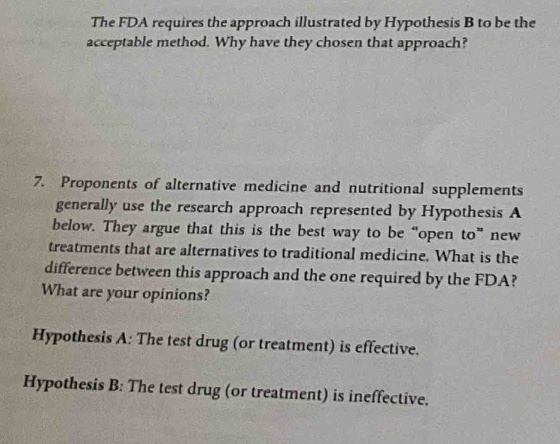
the fda requires the approach illustrated by hypothesis b to be the acceptable method. why have they chosen that approach?\n7. proponents of alternative medicine and nutritional supplements generally use the research approach represented by hypothesis a below. they argue that this is the best way to be “open to” new treatments that are alternatives to traditional medicine. what is the difference between this approach and the one required by the fda? what are your opinions?\nhypothesis a: the test drug (or treatment) is effective.\nhypothesis b: the test drug (or treatment) is ineffective.
Answer
Brief Explanations:
The FDA uses Hypothesis B (drug is ineffective) as a conservative approach. Starting with the assumption of ineffectiveness requires strong evidence to prove otherwise, ensuring safety and efficacy. Proponents of alternative medicine use Hypothesis A (drug is effective), which is more open - minded but may lead to less rigorous testing. The difference lies in the starting assumption and the burden of proof. My opinion is that the FDA's approach is more cautious and helps protect public health by demanding high - quality evidence, while the alternative approach may be more prone to false claims due to a lack of strict proof requirements.
Answer:
The FDA's approach starts with assuming ineffectiveness, requiring strong evidence to prove effectiveness, which is more cautious for public health. The alternative approach assumes effectiveness, being more open - minded but potentially less rigorous. My opinion is that the FDA's approach is better for protecting public health due to its strict evidence requirements.