7 fill in the blank 1 point\nlodine - 131 decreases 50% every day. about how much is left from a 50 - gram…
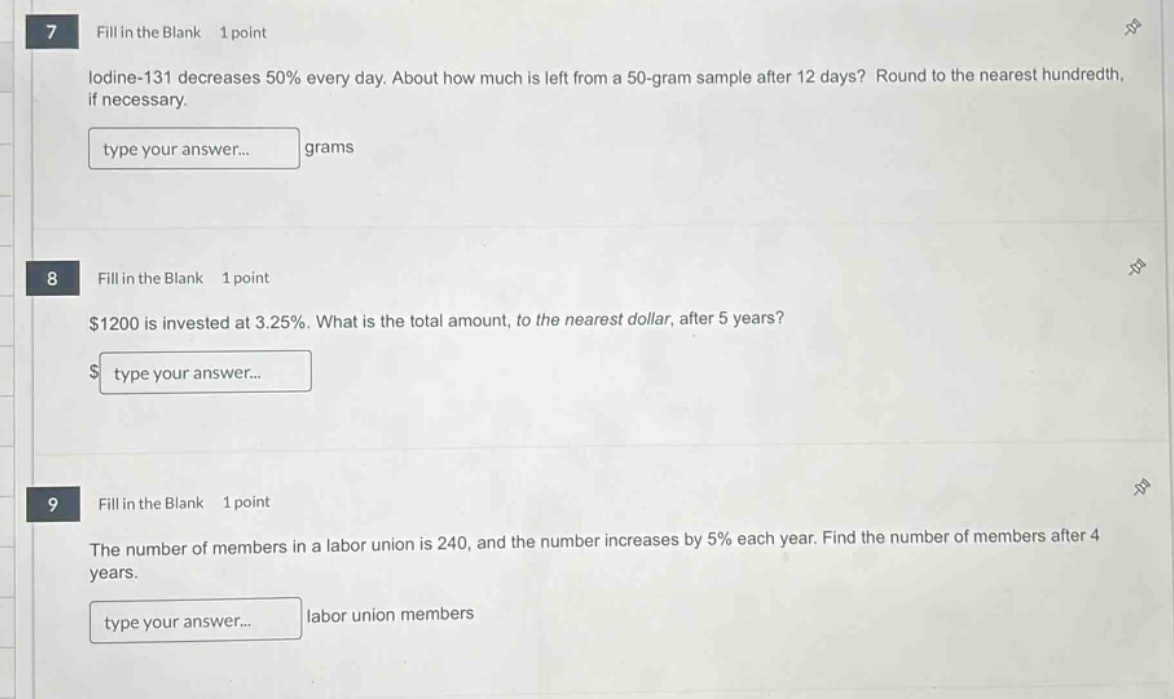
7 fill in the blank 1 point\nlodine - 131 decreases 50% every day. about how much is left from a 50 - gram sample after 12 days? round to the nearest hundredth, if necessary.\ntype your answer... grams\n8 fill in the blank 1 point\n$1200 is invested at 3.25%. what is the total amount, to the nearest dollar, after 5 years?\n$ type your answer...\n9 fill in the blank 1 point\nthe number of members in a labor union is 240, and the number increases by 5% each year. find the number of members after 4 years.\ntype your answer... labor union members
Answer
Question 7
Answer:
0.01
Explanation:
Step1: Identify the decay formula
The formula for exponential decay is $A = A_0(1 - r)^t$, where $A_0$ is the initial amount, $r$ is the rate of decay, and $t$ is the time. Here, $A_0=50$, $r = 0.5$, and $t = 12$.
Step2: Substitute values into the formula
$A=50\times(1 - 0.5)^{12}=50\times0.5^{12}$.
Step3: Calculate the result
$0.5^{12}=\frac{1}{2^{12}}=\frac{1}{4096}$, and $50\times\frac{1}{4096}\approx0.0122$. Rounding to the nearest hundred - th gives 0.01.
Question 8
Answer:
1408
Explanation:
Step1: Identify the compound - interest formula
The compound - interest formula is $A=P(1 + r)^t$, where $P$ is the principal amount, $r$ is the annual interest rate (in decimal form), and $t$ is the number of years. Here, $P = 1200$, $r=0.0325$, and $t = 5$.
Step2: Substitute values into the formula
$A = 1200\times(1+0.0325)^{5}$.
Step3: Calculate $(1 + 0.0325)^{5}$
$(1 + 0.0325)^{5}=1.0325^{5}\approx1.1733$.
Step4: Calculate the total amount
$A=1200\times1.1733 = 1407.96\approx1408$.
Question 9
Answer:
291
Explanation:
Step1: Identify the growth formula
The formula for exponential growth is $A = A_0(1 + r)^t$, where $A_0$ is the initial amount, $r$ is the rate of growth, and $t$ is the time. Here, $A_0 = 240$, $r=0.05$, and $t = 4$.
Step2: Substitute values into the formula
$A=240\times(1 + 0.05)^{4}$.
Step3: Calculate $(1 + 0.05)^{4}$
$(1 + 0.05)^{4}=1.05^{4}=1.05\times1.05\times1.05\times1.05=1.21550625$.
Step4: Calculate the number of members
$A=240\times1.21550625 = 291.7215\approx291$.