find the cubic function that is the best fit for f(x) defined by the following table.\n| x | 0 | 1 | 2 | 3 |…
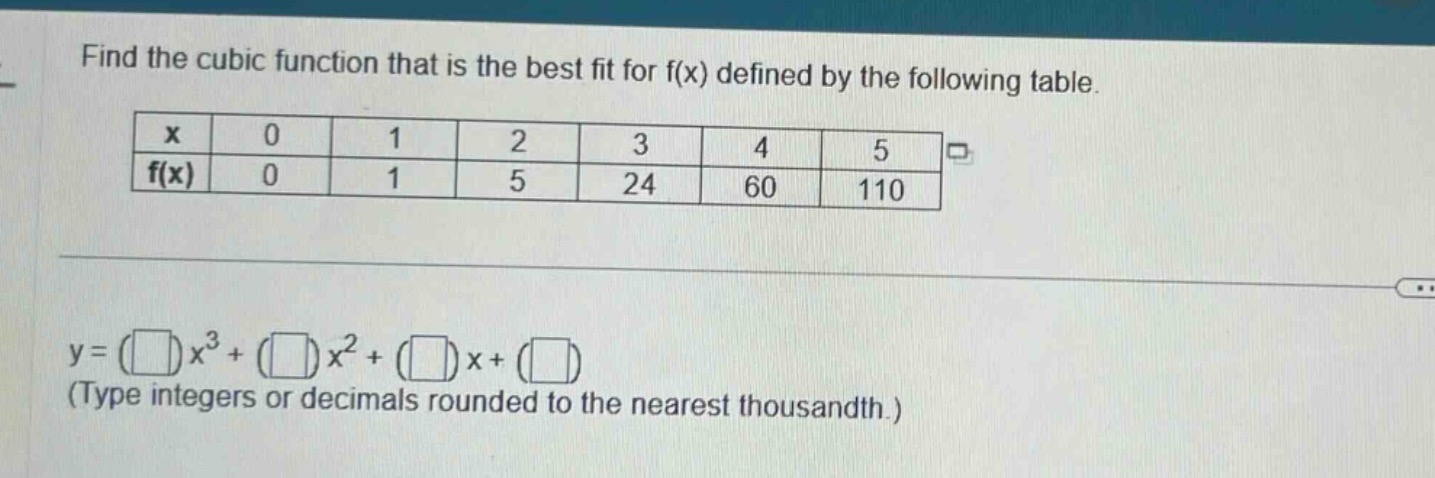
find the cubic function that is the best fit for f(x) defined by the following table.\n| x | 0 | 1 | 2 | 3 | 4 | 5 |\n| f(x) | 0 | 1 | 5 | 24 | 60 | 110 |\ny = ( )x³ + ( )x² + ( )x + ( )\n(type integers or decimals rounded to the nearest thousandth.)
Answer
Explanation:
Step1: Set up the cubic function
Let the cubic function be $y = ax^{3}+bx^{2}+cx + d$. We have 6 data - points $(x_i,y_i)$ where $x_i$ are the values in the $x$ - column and $y_i$ are the values in the $f(x)$ - column of the table. We will substitute these points into the cubic function to get a system of linear equations. When $x = 0$ and $y = 0$: $0=a(0)^{3}+b(0)^{2}+c(0)+d$, so $d = 0$. When $x = 1$ and $y = 1$: $1=a(1)^{3}+b(1)^{2}+c(1)+0=a + b + c$. When $x = 2$ and $y = 5$: $5=a(2)^{3}+b(2)^{2}+c(2)+0=8a + 4b+2c$. When $x = 3$ and $y = 24$: $24=a(3)^{3}+b(3)^{2}+c(3)+0=27a+9b + 3c$. When $x = 4$ and $y = 60$: $60=a(4)^{3}+b(4)^{2}+c(4)+0=64a+16b + 4c$. When $x = 5$ and $y = 110$: $110=a(5)^{3}+b(5)^{2}+c(5)+0=125a+25b + 5c$.
We can rewrite the non - zero equations as a system of linear equations: $\begin{cases}a + b + c=1\8a + 4b+2c=5\27a+9b + 3c=24\64a+16b + 4c=60\125a+25b + 5c=110\end{cases}$
We can use matrix methods or elimination methods to solve this system. First, we can simplify the equations by dividing the second, third, fourth and fifth equations by 2, 3, 4 and 5 respectively: $\begin{cases}a + b + c=1\4a + 2b+c=\frac{5}{2}\9a+3b + c=8\16a+4b + c = 15\25a+5b + c=22\end{cases}$
Subtract the first equation from the second, third, fourth and fifth equations: $\begin{cases}a + b + c=1\3a + b=\frac{3}{2}\8a+2b = 7\15a+3b = 14\24a+4b=21\end{cases}$
Subtract 2 times the second equation from the third equation, 3 times the second equation from the fourth equation and 4 times the second equation from the fifth equation: $\begin{cases}a + b + c=1\3a + b=\frac{3}{2}\2a=4\6a=\frac{19}{2}\12a=\frac{39}{2}\end{cases}$
From $2a = 4$, we get $a = 2$. Substitute $a = 2$ into $3a + b=\frac{3}{2}$, we have $3\times2 + b=\frac{3}{2}$, so $b=-\frac{9}{2}$. Substitute $a = 2$ and $b = -\frac{9}{2}$ into $a + b + c=1$, we get $2-\frac{9}{2}+c=1$, so $c=\frac{7}{2}$.
Step2: Write the cubic function
The cubic function is $y = 2x^{3}-\frac{9}{2}x^{2}+\frac{7}{2}x+0$. Rounding to the nearest thousandth, $y = 2.000x^{3}-4.500x^{2}+3.500x+0.000$
Answer:
$y = 2.000x^{3}-4.500x^{2}+3.500x+0.000$