find the experimental probability that only 1 of 4 children in a family is a girl. the problem has been…
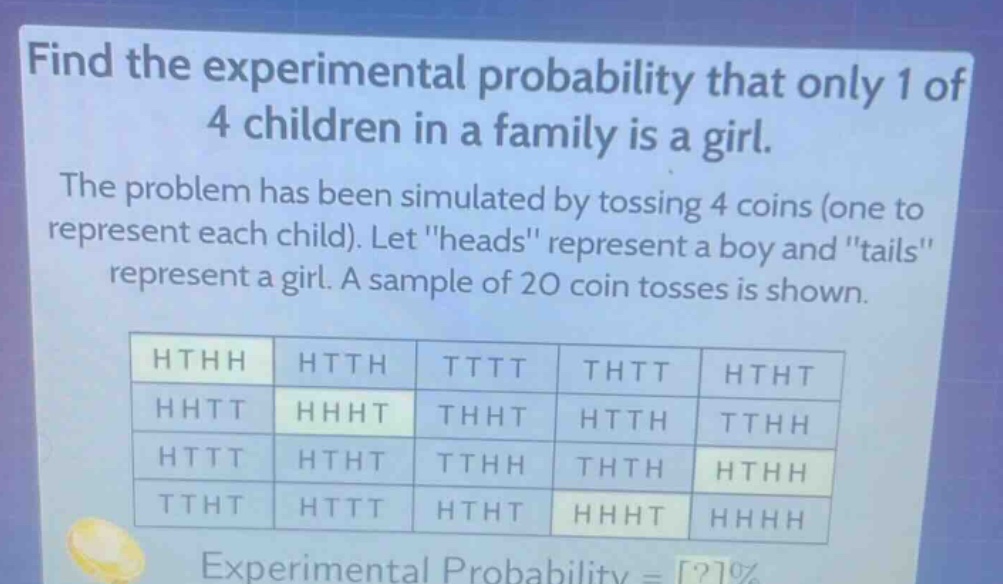
find the experimental probability that only 1 of 4 children in a family is a girl. the problem has been simulated by tossing 4 coins (one to represent each child). let \heads\ represent a boy and \tails\ represent a girl. a sample of 20 coin tosses is shown. hthh htth tttt thtt htht hhtt hhht thht htth tthh httt htht tthh thth hthh ttht httt htht hhht hhhh experimental probability = ?%
Answer
Explanation:
Step1: Identify favorable outcomes
Count the number of sequences with 1 tail.
Step2: Count favorable sequences
Sequences with 1 tail are HTHH, HHTT, HHHT, HTHH, HHHT. There are 5 such sequences.
Step3: Calculate experimental - probability
The experimental probability $P=\frac{\text{Number of favorable outcomes}}{\text{Total number of outcomes}}$. Here, the total number of coin - tosses (outcomes) is 20. So $P=\frac{5}{20}$.
Step4: Convert to percentage
$P=\frac{5}{20}\times100% = 25%$.
Answer:
25%