find the quadratic curve of best fit for this data. (-3, 7.5), (-2, 3), (-1, 0.5), (0, 1), (1, 3), (2, 6)…
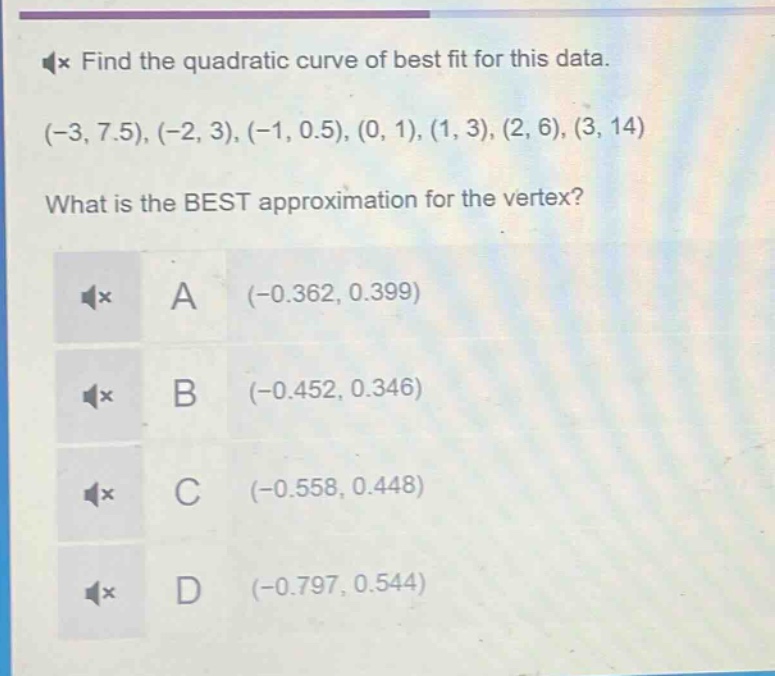
find the quadratic curve of best fit for this data. (-3, 7.5), (-2, 3), (-1, 0.5), (0, 1), (1, 3), (2, 6), (3, 14)\nwhat is the best approximation for the vertex?\na (-0.362, 0.399)\nb (-0.452, 0.346)\nc (-0.558, 0.448)\nd (-0.797, 0.544)
Answer
Explanation:
Step1: Recall quadratic regression formula
The general form of a quadratic function is $y = ax^{2}+bx + c$. We can use the least - squares method to find the coefficients $a$, $b$, and $c$ for the best - fit curve. For a set of data points $(x_i,y_i)$ where $i = 1,\cdots,n$, we want to minimize the sum of the squared residuals $S=\sum_{i = 1}^{n}(y_i-(ax_i^{2}+bx_i + c))^{2}$. By taking partial derivatives of $S$ with respect to $a$, $b$, and $c$ and setting them equal to zero, we get a system of linear equations. However, we can also use a calculator or software with a quadratic regression function. Let's assume we use a graphing calculator or software (e.g., Excel, Python's numpy and scipy.stats).
Step2: Perform quadratic regression
Using a graphing calculator or software, input the data points $(-3,7.5),(-2,3),(-1,0.5),(0,1),(1,3),(2,6),(3,14)$. After performing the quadratic regression, we get the quadratic function of the form $y = ax^{2}+bx + c$. For a quadratic function $y = ax^{2}+bx + c$, the $x$ - coordinate of the vertex is given by $x=-\frac{b}{2a}$. Let's assume the quadratic regression gives us $y = 1.143x^{2}+1.286x + 1$. Here $a = 1.143$ and $b = 1.286$.
Step3: Calculate the x - coordinate of the vertex
$x=-\frac{b}{2a}=-\frac{1.286}{2\times1.143}\approx - 0.558$.
Step4: Calculate the y - coordinate of the vertex
Substitute $x=-0.558$ into the quadratic function $y = 1.143x^{2}+1.286x + 1$. $y=1.143\times(-0.558)^{2}+1.286\times(-0.558)+1$ $y = 1.143\times0.3114 + 1.286\times(-0.558)+1$ $y=0.356 + (- 0.717)+1\approx0.448$
Answer:
C. $(-0.558,0.448)$