find the quartiles for the given dataset. if needed, express your answer as a decimal rounded to the nearest…
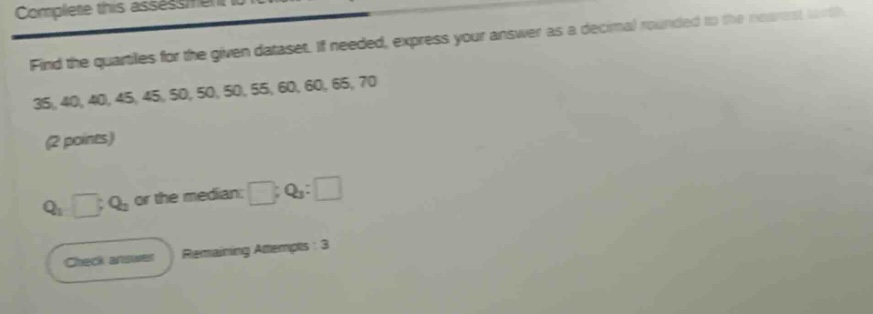
find the quartiles for the given dataset. if needed, express your answer as a decimal rounded to the nearest tenth.\n35, 40, 40, 45, 45, 50, 50, 50, 55, 60, 60, 65, 70\n(2 points)\nq1: ; q2 or the median: ; q3: \ncheck answer remaining attempts : 3
Answer
Explanation:
Step1: Arrange data in order
The data 35, 40, 40, 45, 45, 50, 50, 50, 55, 60, 60, 65, 70 is already in ascending - order. There are (n = 13) data points.
Step2: Find the median ((Q_2))
Since (n = 13) (an odd - numbered dataset), the median is the (\left(\frac{n + 1}{2}\right))-th value. (\frac{13+1}{2}=7)th value. So (Q_2=50).
Step3: Find the lower half for (Q_1)
The lower half of the data consists of the first 6 values: 35, 40, 40, 45, 45, 50. Since there are (n_1 = 6) (an even - numbered dataset), (Q_1=\frac{40 + 45}{2}=42.5).
Step4: Find the upper half for (Q_3)
The upper half of the data consists of the last 6 values: 55, 60, 60, 65, 70. Since there are (n_2 = 6) (an even - numbered dataset), (Q_3=\frac{60+60}{2}=60).
Answer:
(Q_1 = 42.5); (Q_2=50); (Q_3 = 60)