find the standard deviation for the given set of data. round your answer to the nearest tenth.\n{3, 5, 6, 7…
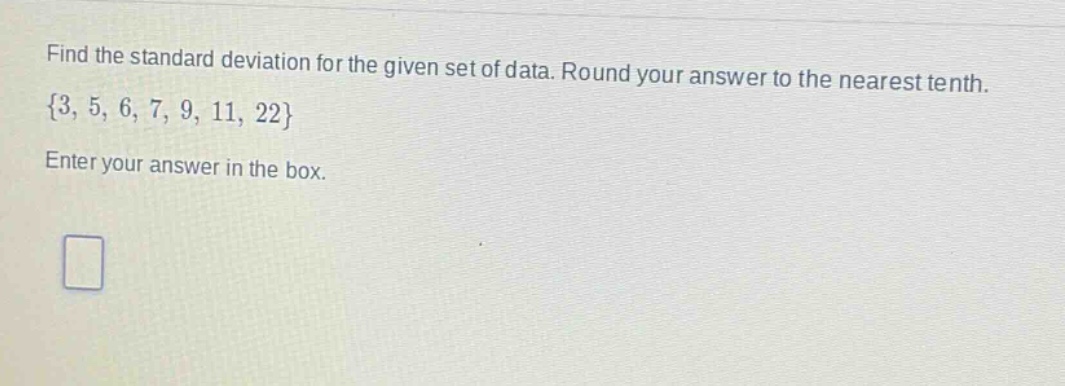
find the standard deviation for the given set of data. round your answer to the nearest tenth.\n{3, 5, 6, 7, 9, 11, 22}\nenter your answer in the box.
Answer
Explanation:
Step1: Calculate the mean
The mean $\bar{x}$ of a data set ${x_1,x_2,\cdots,x_n}$ is given by $\bar{x}=\frac{\sum_{i = 1}^{n}x_i}{n}$. Here, $n = 7$, and $\sum_{i=1}^{7}x_i=3 + 5+6+7+9+11+22=63$. So, $\bar{x}=\frac{63}{7}=9$.
Step2: Calculate the squared differences
For each data point $x_i$, calculate $(x_i-\bar{x})^2$:
- When $x_1 = 3$, $(3 - 9)^2=(-6)^2 = 36$.
- When $x_2 = 5$, $(5 - 9)^2=(-4)^2 = 16$.
- When $x_3 = 6$, $(6 - 9)^2=(-3)^2 = 9$.
- When $x_4 = 7$, $(7 - 9)^2=(-2)^2 = 4$.
- When $x_5 = 9$, $(9 - 9)^2=0^2 = 0$.
- When $x_6 = 11$, $(11 - 9)^2=2^2 = 4$.
- When $x_7 = 22$, $(22 - 9)^2=13^2 = 169$.
Step3: Calculate the variance
The variance $s^2$ (for a sample) is given by $s^2=\frac{\sum_{i = 1}^{n}(x_i-\bar{x})^2}{n - 1}$. $\sum_{i = 1}^{7}(x_i-\bar{x})^2=36+16+9+4+0+4+169 = 248$. So, $s^2=\frac{248}{7-1}=\frac{248}{6}\approx41.33$.
Step4: Calculate the standard deviation
The standard deviation $s=\sqrt{s^2}$. $s=\sqrt{\frac{248}{6}}\approx\sqrt{41.33}\approx6.4$.
Answer:
$6.4$