finding experimental probability\non a nearby pond, black and white ducks are swimming in groups of three…
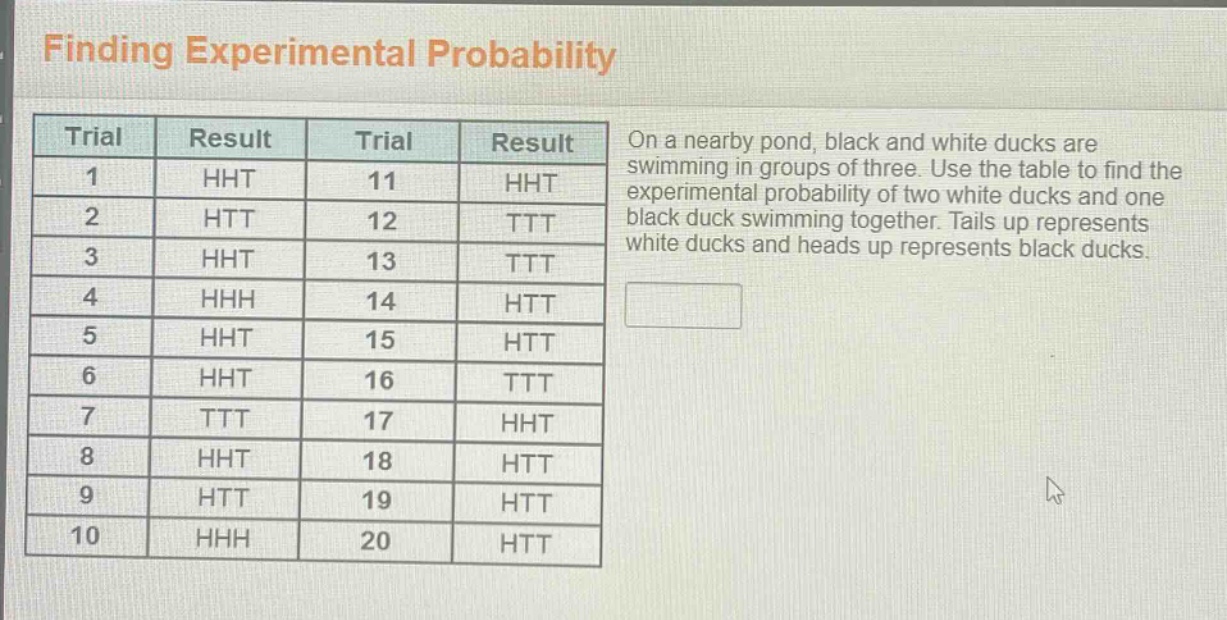
finding experimental probability\non a nearby pond, black and white ducks are swimming in groups of three. use the table to find the experimental probability of two white ducks and one black duck swimming together. tails up represents white ducks and heads up represents black ducks.\ntrial result trial result\n1 hht 11 hht\n2 htt 12 ttt\n3 hht 13 ttt\n4 hhh 14 htt\n5 hht 15 htt\n6 hht 16 ttt\n7 ttt 17 hht\n8 hht 18 htt\n9 htt 19 htt\n10 hhh 20 htt
Answer
Explanation:
Step1: Identify favorable outcomes
We want two white ducks (tails - T) and one black duck (heads - H), so the favorable outcomes are HTT. Count the number of HTT in the table.
Step2: Count total number of trials
There are 20 trials in total.
Step3: Calculate experimental probability
The experimental probability $P$ is given by the formula $P=\frac{\text{Number of favorable outcomes}}{\text{Total number of trials}}$. The number of HTT is 7. So $P = \frac{7}{20}=0.35$.
Answer:
$0.35$