fiona chooses three towels from a group of five to pack in her beach bag for herself and her two brothers…
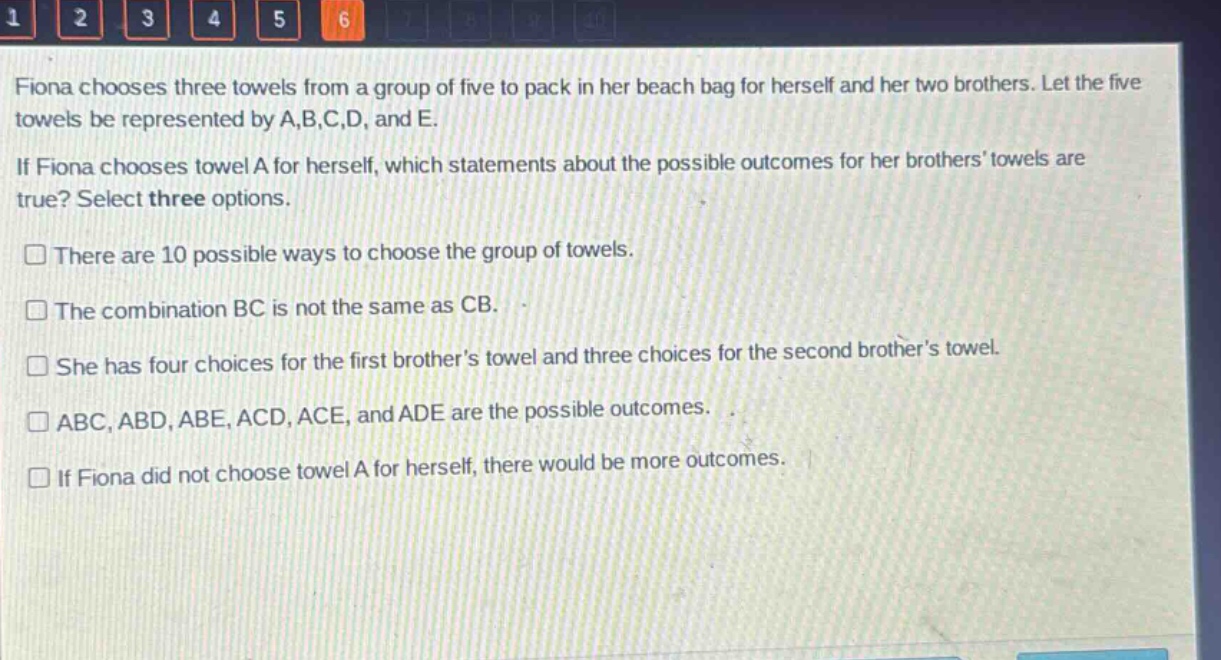
fiona chooses three towels from a group of five to pack in her beach bag for herself and her two brothers. let the five towels be represented by a,b,c,d, and e. if fiona chooses towel a for herself, which statements about the possible outcomes for her brothers’ towels are true? select three options. there are 10 possible ways to choose the group of towels. the combination bc is not the same as cb. she has four choices for the first brother’s towel and three choices for the second brother’s towel. abc, abd, abe, acd, ace, and ade are the possible outcomes. if fiona did not choose towel a for herself, there would be more outcomes.
Answer
Explanation:
Step1: Analyze number of ways to choose
Since Fiona has already chosen towel A for herself, we need to choose 2 towels out of the remaining 4 for her two brothers. The number of ways to choose 2 items out of 4 is given by the combination formula $C(n,k)=\frac{n!}{k!(n - k)!}$, where $n = 4$ and $k=2$. $C(4,2)=\frac{4!}{2!(4 - 2)!}=\frac{4!}{2!2!}=\frac{4\times3\times2!}{2!×2!}=6$. So the statement "There are 10 possible ways to choose the group of towels" is false.
Step2: Understand combination concept
In combinations, the combination BC is the same as CB because the order of selection does not matter. So the statement "The combination BC is not the same as CB" is false.
Step3: Count choices for brothers
After choosing towel A for herself, she has 4 choices for the first - brother's towel. After giving a towel to the first brother, she has 3 choices for the second brother's towel. This is a correct way to think about the number of ways to distribute the towels to the two brothers.
Step4: List possible outcomes
Since she has chosen A for herself, the possible combinations of the remaining two - towel selections from B, C, D, E for her brothers are: ABC, ABD, ABE, ACD, ACE, ADE.
Step5: Consider alternative scenario
If Fiona did not choose towel A for herself, she would be choosing 3 towels out of 5. The number of ways to choose 3 items out of 5 is $C(5,3)=\frac{5!}{3!(5 - 3)!}=\frac{5!}{3!2!}=\frac{5\times4\times3!}{3!×2!}=10$, which is more than the 6 ways when she has already chosen A for herself.
Answer:
She has four choices for the first brother's towel and three choices for the second brother's towel. ABC, ABD, ABE, ACD, ACE, and ADE are the possible outcomes. If Fiona did not choose towel A for herself, there would be more outcomes.