a florist wants to determine if a new additive would extend the life of cut flowers longer than the original…
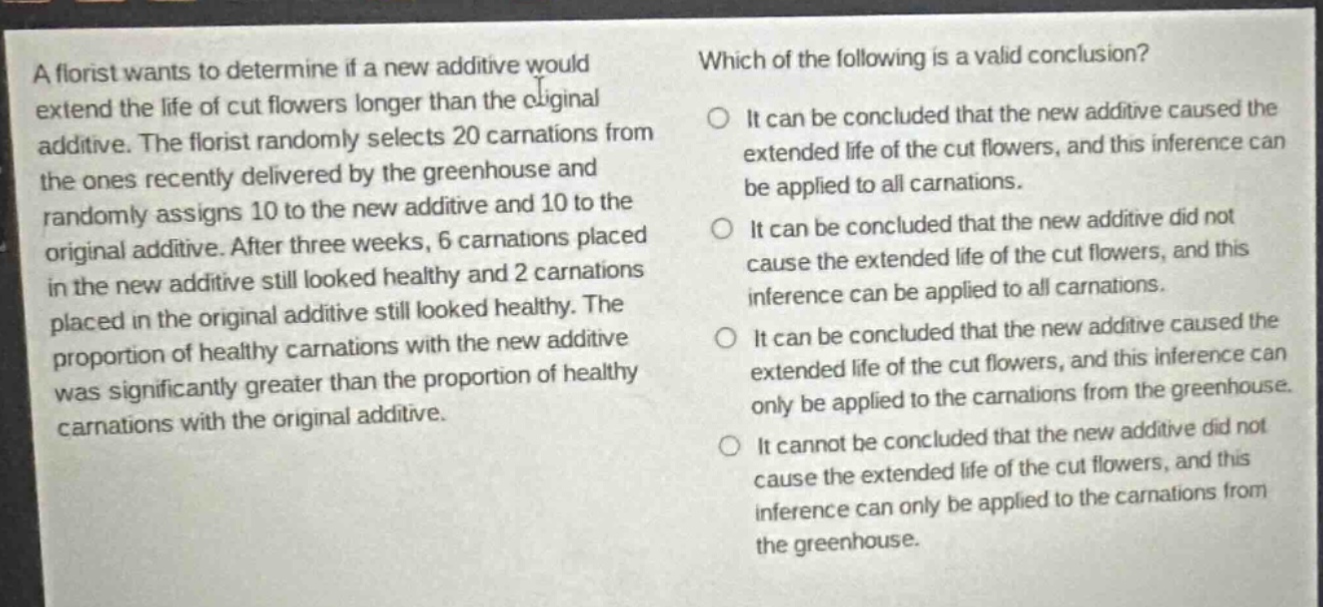
a florist wants to determine if a new additive would extend the life of cut flowers longer than the original additive. the florist randomly selects 20 carnations from the ones recently delivered by the greenhouse and randomly assigns 10 to the new additive and 10 to the original additive. after three weeks, 6 carnations placed in the new additive still looked healthy and 2 carnations placed in the original additive still looked healthy. the proportion of healthy carnations with the new additive was significantly greater than the proportion of healthy carnations with the original additive. which of the following is a valid conclusion? it can be concluded that the new additive caused the extended life of the cut flowers, and this inference can be applied to all carnations. it can be concluded that the new additive did not cause the extended life of the cut flowers, and this inference can be applied to all carnations. it can be concluded that the new additive caused the extended life of the cut flowers, and this inference can only be applied to the carnations from the greenhouse. it cannot be concluded that the new additive did not cause the extended life of the cut flowers, and this inference can only be applied to the carnations from the greenhouse.
Answer
Brief Explanations:
The experiment only used carnations from a specific greenhouse. The sample is not representative of all carnations. Just because the new additive had a better - result on these greenhouse carnations doesn't mean it will work the same way for all carnations. Also, while the proportion of healthy carnations was higher with the new additive, we can't be sure it was the additive that caused the extended life. There could be other factors at play.
Answer:
It cannot be concluded that the new additive caused the extended life of the cut flowers, and this inference can only be applied to the carnations from the greenhouse.