which of the following probabilities is equal to approximately 0.2957? use the portion of the standard…
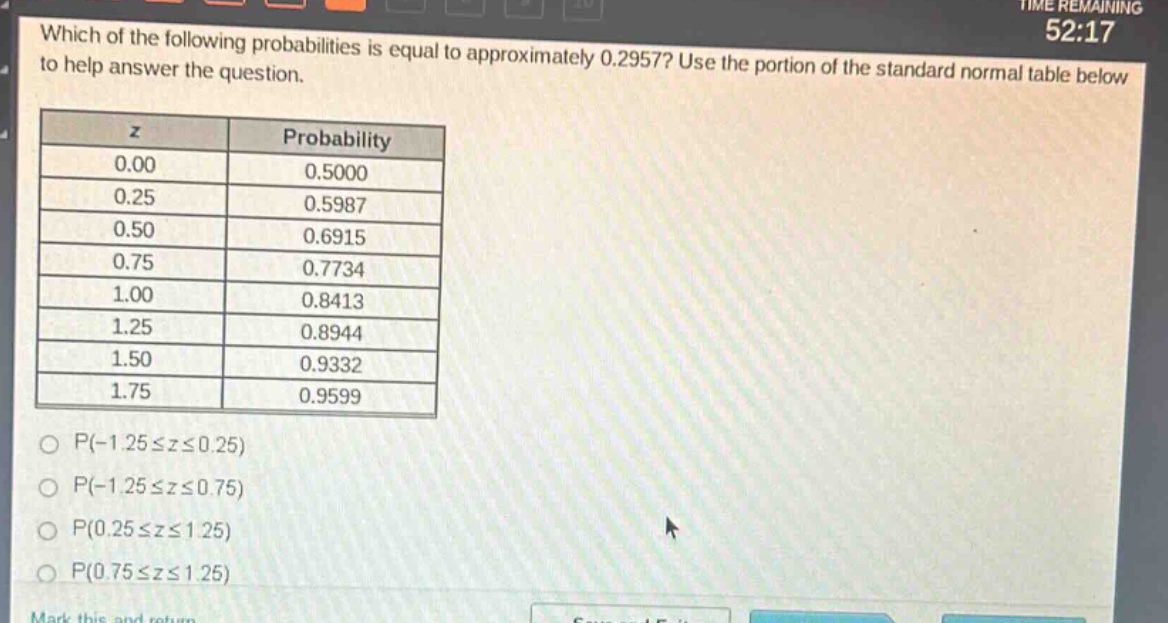
which of the following probabilities is equal to approximately 0.2957? use the portion of the standard normal table below to help answer the question.\n| z | probability |\n| ---- | ---- |\n| 0.00 | 0.5000 |\n| 0.25 | 0.5987 |\n| 0.50 | 0.6915 |\n| 0.75 | 0.7734 |\n| 1.00 | 0.8413 |\n| 1.25 | 0.8944 |\n| 1.50 | 0.9332 |\n| 1.75 | 0.9599 |\np(-1.25≤z≤0.25)\np(-1.25≤z≤0.75)\np(0.25≤z≤1.25)\np(0.75≤z≤1.25)
Answer
Explanation:
Step1: Recall the property of standard - normal distribution
The probability $P(a\leq z\leq b)=P(z\leq b)-P(z\leq a)$. Also, $P(z\leq - x)=1 - P(z\leq x)$ for a standard - normal random variable $z$.
Step2: Calculate $P(-1.25\leq z\leq0.25)$
$P(-1.25\leq z\leq0.25)=P(z\leq0.25)-P(z\leq - 1.25)$. Since $P(z\leq - 1.25)=1 - P(z\leq1.25)$, then $P(-1.25\leq z\leq0.25)=P(z\leq0.25)-(1 - P(z\leq1.25))$. From the table, $P(z\leq0.25) = 0.5987$ and $P(z\leq1.25)=0.8944$. So $P(-1.25\leq z\leq0.25)=0.5987-(1 - 0.8944)=0.5987 - 0.1056=0.4931$.
Step3: Calculate $P(-1.25\leq z\leq0.75)$
$P(-1.25\leq z\leq0.75)=P(z\leq0.75)-P(z\leq - 1.25)=P(z\leq0.75)-(1 - P(z\leq1.25))$. From the table, $P(z\leq0.75)=0.7734$ and $P(z\leq1.25)=0.8944$. So $P(-1.25\leq z\leq0.75)=0.7734-(1 - 0.8944)=0.7734 - 0.1056 = 0.6678$.
Step4: Calculate $P(0.25\leq z\leq1.25)$
$P(0.25\leq z\leq1.25)=P(z\leq1.25)-P(z\leq0.25)$. From the table, $P(z\leq1.25)=0.8944$ and $P(z\leq0.25)=0.5987$. So $P(0.25\leq z\leq1.25)=0.8944 - 0.5987=0.2957$.
Step5: Calculate $P(0.75\leq z\leq1.25)$
$P(0.75\leq z\leq1.25)=P(z\leq1.25)-P(z\leq0.75)$. From the table, $P(z\leq1.25)=0.8944$ and $P(z\leq0.75)=0.7734$. So $P(0.75\leq z\leq1.25)=0.8944 - 0.7734 = 0.121$.
Answer:
$P(0.25\leq z\leq1.25)$