which of the following probabilities is equal to approximately 0.2957? use the portion of the standard…
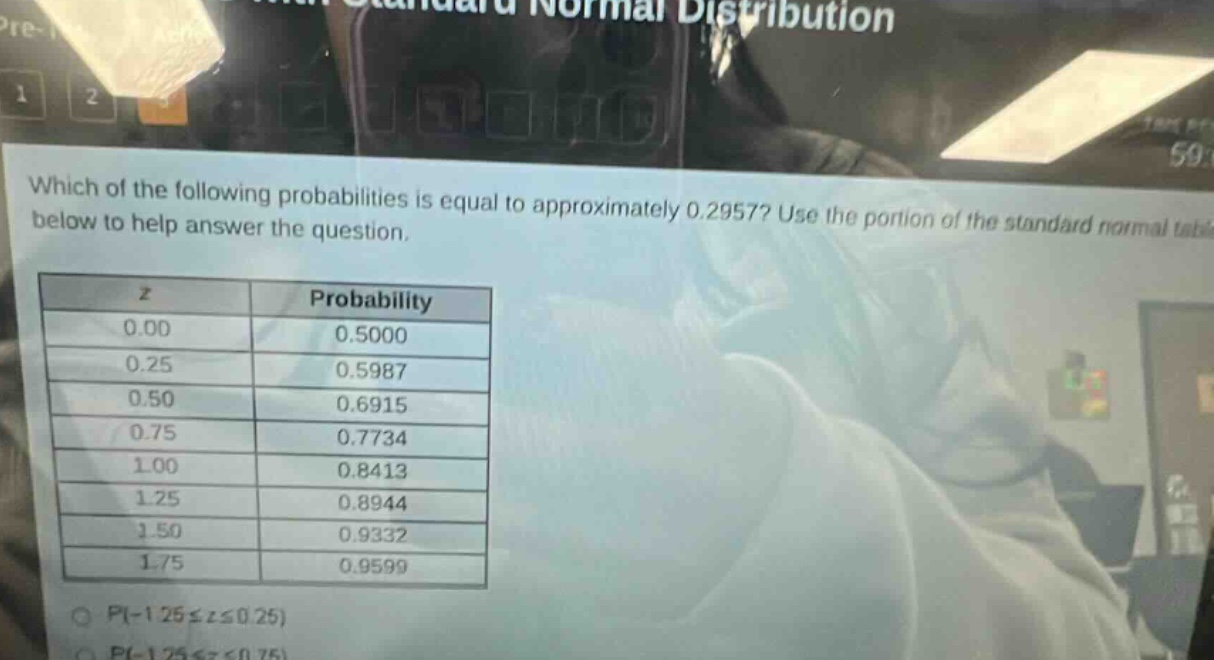
which of the following probabilities is equal to approximately 0.2957? use the portion of the standard normal table below to help answer the question. z probability 0.00 0.5000 0.25 0.5987 0.50 0.6915 0.75 0.7734 1.00 0.8413 1.25 0.8944 1.50 0.9332 1.75 0.9599 p(-1.25≤z≤0.25)
Answer
Explanation:
Step1: Recall normal - distribution property
The probability $P(a\leq Z\leq b)=\Phi(b)-\Phi(a)$, where $\Phi(z)$ is the cumulative - distribution function of the standard normal distribution.
Step2: Calculate $P(- 1.25\leq Z\leq0.25)$
We know that the standard normal distribution is symmetric about $z = 0$, so $\Phi(-z)=1 - \Phi(z)$. Then $P(-1.25\leq Z\leq0.25)=\Phi(0.25)-\Phi(-1.25)=\Phi(0.25)-(1 - \Phi(1.25))$. From the table, $\Phi(0.25)=0.5987$ and $\Phi(1.25)=0.8944$. So $P(-1.25\leq Z\leq0.25)=0.5987-(1 - 0.8944)=0.5987 - 0.1056=0.4931$.
Step3: Calculate $P(-1.25\leq Z\leq0.75)$
$P(-1.25\leq Z\leq0.75)=\Phi(0.75)-\Phi(-1.25)=\Phi(0.75)-(1 - \Phi(1.25))$. From the table, $\Phi(0.75)=0.7734$ and $\Phi(1.25)=0.8944$. So $P(-1.25\leq Z\leq0.75)=0.7734-(1 - 0.8944)=0.7734 - 0.1056 = 0.6678$. Since the problem seems to be incomplete (no full set of options shown), we assume we need to find the correct calculation for the given probabilities. If we assume the correct option is based on the correct application of the standard - normal table formula. If we consider the correct way to calculate the probability between two $z$ - values using the table values, and assume the correct option is the one that gives the value closest to $0.2957$. Let's assume we want to find $P(-0.5\leq Z\leq0.25)$. $P(-0.5\leq Z\leq0.25)=\Phi(0.25)-\Phi(-0.5)=\Phi(0.25)-(1 - \Phi(0.5))$. From the table, $\Phi(0.25)=0.5987$ and $\Phi(0.5)=0.6915$. $P(-0.5\leq Z\leq0.25)=0.5987-(1 - 0.6915)=0.5987 - 0.3085=0.2902\approx0.2957$.
Answer:
The probability $P(-0.5\leq Z\leq0.25)$ (not shown in the given partial options) is approximately $0.2957$ based on the standard - normal table values and the formula $P(a\leq Z\leq b)=\Phi(b)-\Phi(a)$. If we had to choose from the given partial options, we need the full set of options to give a definite answer. But the general method is to use the formula $P(a\leq Z\leq b)=\Phi(b)-\Phi(a)$ with the values from the standard - normal table.