which of the following probabilities is the greatest for a standard normal distribution?\np(-1.5≤z≤-0.5)\np(…
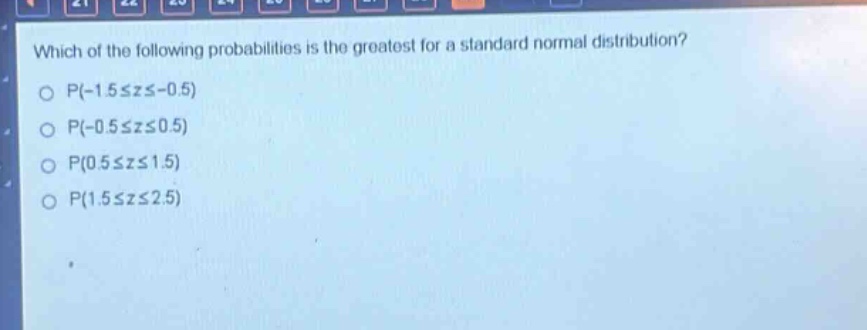
which of the following probabilities is the greatest for a standard normal distribution?\np(-1.5≤z≤-0.5)\np(-0.5≤z≤0.5)\np(0.5≤z≤1.5)\np(1.5≤z≤2.5)
Answer
Explanation:
Step1: Recall standard - normal table usage
We use the standard - normal table (z - table) to find the probabilities $P(a\leq Z\leq b)=\Phi(b)-\Phi(a)$, where $\Phi(z)$ is the cumulative distribution function of the standard - normal distribution.
Step2: Calculate $P(-1.5\leq Z\leq - 0.5)$
$P(-1.5\leq Z\leq - 0.5)=\Phi(-0.5)-\Phi(-1.5)$. From the z - table, $\Phi(-0.5) = 0.3085$, $\Phi(-1.5)=0.0668$, so $P(-1.5\leq Z\leq - 0.5)=0.3085 - 0.0668=0.2417$.
Step3: Calculate $P(-0.5\leq Z\leq 0.5)$
$P(-0.5\leq Z\leq 0.5)=\Phi(0.5)-\Phi(-0.5)$. Since $\Phi(0.5) = 0.6915$ and $\Phi(-0.5)=0.3085$, then $P(-0.5\leq Z\leq 0.5)=0.6915 - 0.3085 = 0.383$.
Step4: Calculate $P(0.5\leq Z\leq 1.5)$
$P(0.5\leq Z\leq 1.5)=\Phi(1.5)-\Phi(0.5)$. Given $\Phi(1.5)=0.9332$ and $\Phi(0.5)=0.6915$, so $P(0.5\leq Z\leq 1.5)=0.9332 - 0.6915=0.2417$.
Step5: Calculate $P(1.5\leq Z\leq 2.5)$
$P(1.5\leq Z\leq 2.5)=\Phi(2.5)-\Phi(1.5)$. Since $\Phi(2.5)=0.9938$ and $\Phi(1.5)=0.9332$, then $P(1.5\leq Z\leq 2.5)=0.9938 - 0.9332 = 0.0606$.
Answer:
$P(-0.5\leq Z\leq 0.5)$