which of the following probabilities is the greatest for a standard normal distribution?\no…
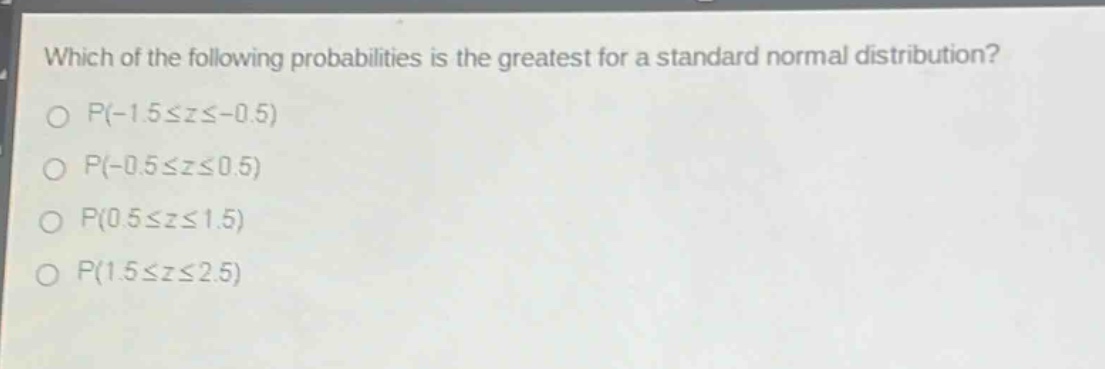
which of the following probabilities is the greatest for a standard normal distribution?\no p(-1.5≤z≤-0.5)\no p(-0.5≤z≤0.5)\no p(0.5≤z≤1.5)\no p(1.5≤z≤2.5)
Answer
Explanation:
Step1: Recall standard - normal property
The standard - normal distribution $N(0,1)$ is symmetric about $z = 0$. The probability $P(a\leq z\leq b)=\Phi(b)-\Phi(a)$, where $\Phi(z)$ is the cumulative - distribution function of the standard - normal distribution.
Step2: Analyze each option
- Option 1: $P(-1.5\leq z\leq - 0.5)=\Phi(-0.5)-\Phi(-1.5)$. Using the property $\Phi(-z)=1 - \Phi(z)$, we have $P(-1.5\leq z\leq - 0.5)=(1 - \Phi(0.5))-(1 - \Phi(1.5))=\Phi(1.5)-\Phi(0.5)$.
- Option 2: $P(-0.5\leq z\leq0.5)=\Phi(0.5)-\Phi(-0.5)=\Phi(0.5)-(1 - \Phi(0.5)) = 2\Phi(0.5)-1$.
- Option 3: $P(0.5\leq z\leq1.5)=\Phi(1.5)-\Phi(0.5)$.
- Option 4: $P(1.5\leq z\leq2.5)=\Phi(2.5)-\Phi(1.5)$.
Step3: Use the fact that $\Phi(z)$ is an increasing function
The cumulative - distribution function $\Phi(z)$ of the standard - normal distribution is an increasing function of $z$. The area under the standard - normal curve between $z=-0.5$ and $z = 0.5$ is larger than the area between $z=-1.5$ and $z=-0.5$, between $z = 0.5$ and $z = 1.5$, and between $z = 1.5$ and $z = 2.5$. We know that the standard - normal distribution is symmetric about $z = 0$, and the probability of being closer to the mean ($z = 0$) is higher.
Answer:
B. $P(-0.5\leq z\leq0.5)$