for the following set of data, find the sample standard deviation, to the nearest thousandth. 18, 64, 44…
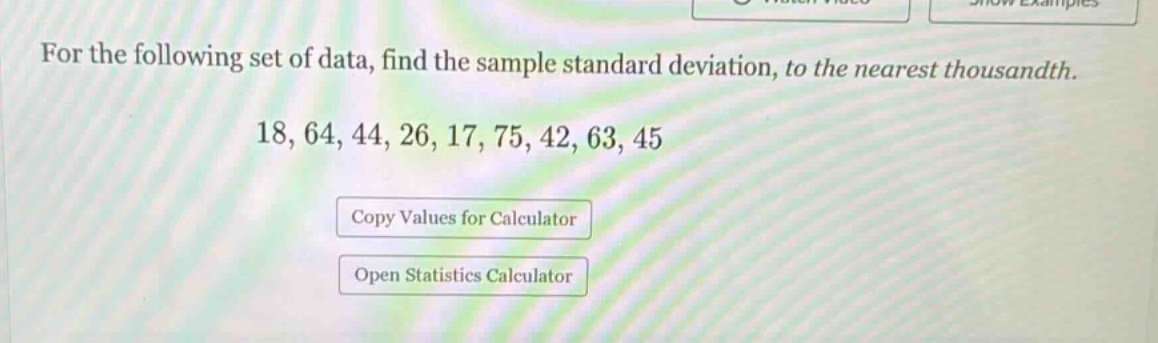
for the following set of data, find the sample standard deviation, to the nearest thousandth. 18, 64, 44, 26, 17, 75, 42, 63, 45
Answer
Explanation:
Step1: Calculate the mean
The mean $\bar{x}=\frac{18 + 64+44+26+17+75+42+63+45}{9}=\frac{394}{9}\approx43.778$.
Step2: Calculate the squared - differences
$(18 - 43.778)^2=(- 25.778)^2 = 664.515$, $(64 - 43.778)^2=(20.222)^2 = 408.939$, $(44 - 43.778)^2=(0.222)^2 = 0.049$, $(26 - 43.778)^2=(-17.778)^2 = 316.065$, $(17 - 43.778)^2=(-26.778)^2 = 716.065$, $(75 - 43.778)^2=(31.222)^2 = 974.815$, $(42 - 43.778)^2=(-1.778)^2 = 3.165$, $(63 - 43.778)^2=(19.222)^2 = 369.499$, $(45 - 43.778)^2=(1.222)^2 = 1.493$.
Step3: Calculate the sum of squared - differences
$S=\sum_{i = 1}^{9}(x_i-\bar{x})^2=664.515 + 408.939+0.049+316.065+716.065+974.815+3.165+369.499+1.493=3454.505$.
Step4: Calculate the sample variance
The sample variance $s^2=\frac{S}{n - 1}=\frac{3454.505}{9 - 1}=\frac{3454.505}{8}=431.813$.
Step5: Calculate the sample standard deviation
The sample standard deviation $s=\sqrt{431.813}\approx20.780$.
Answer:
$20.780$