which of the following statements is equivalent to p(z≥1.7)?\np(z≥ - 1.7)\n1 - p(z≥ - 1.7)\np(z≤1.7)\n1…
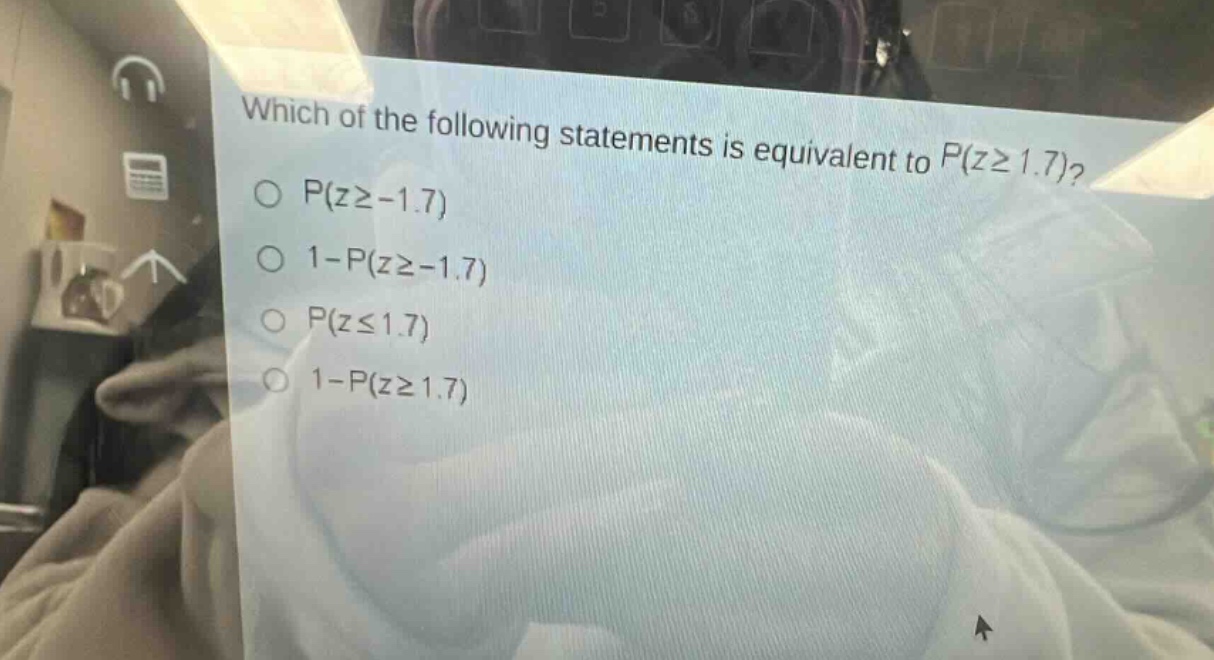
which of the following statements is equivalent to p(z≥1.7)?\np(z≥ - 1.7)\n1 - p(z≥ - 1.7)\np(z≤1.7)\n1 - p(z≥1.7)
Answer
Explanation:
Step1: Recall total - probability rule
The total probability under the standard - normal curve is 1, i.e., $P(-\infty<z<\infty) = 1$. Also, $P(z\geq a)+P(z < a)=1$.
Step2: Analyze the given probability
We know that $P(z\geq1.7)+P(z < 1.7)=1$. So, $P(z\geq1.7)=1 - P(z < 1.7)$. The standard - normal distribution is symmetric about $z = 0$. But the given options do not involve this symmetry property in the correct way for the equivalent of $P(z\geq1.7)$. We know that $P(z\geq1.7)$ and $1 - P(z\geq - 1.7)$ are related. Since the total area under the standard - normal curve is 1, and $P(z\geq - 1.7)$ is the area to the right of $z=-1.7$. The area to the right of $z = 1.7$ is $1 - P(z\geq - 1.7)$ because of the symmetry of the standard - normal distribution about $z = 0$.
Answer:
$1 - P(z\geq - 1.7)$