a food lab conducted a blind taste test to determine if organic fruits taste better than non - organic…
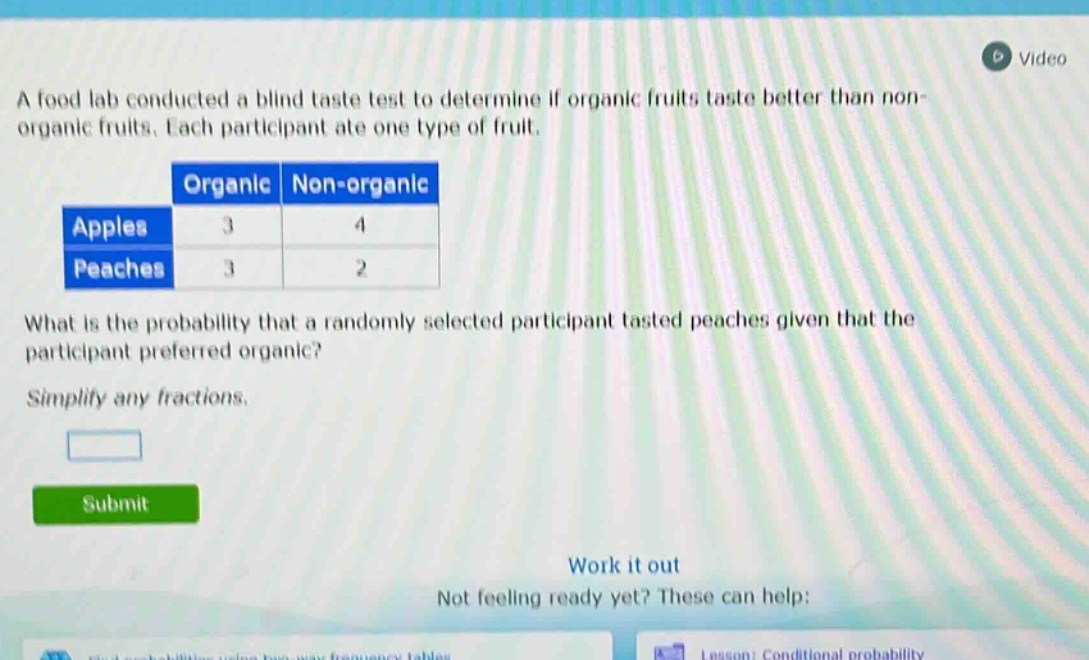
a food lab conducted a blind taste test to determine if organic fruits taste better than non - organic fruits. each participant ate one type of fruit.\n| |organic|non - organic|\n|--|--|--|\n|apples|3|4|\n|peaches|3|2|\nwhat is the probability that a randomly selected participant tasted peaches given that the participant preferred organic?\nsimplify any fractions.
Answer
Explanation:
Step1: Calculate total number of participants who preferred organic
The number of participants who preferred organic apples is 3 and who preferred organic peaches is 3. So the total number of participants who preferred organic is $3 + 3=6$.
Step2: Calculate the number of participants who preferred organic and tasted peaches
The number of participants who preferred organic and tasted peaches is 3.
Step3: Use the conditional - probability formula
The formula for conditional probability $P(A|B)=\frac{P(A\cap B)}{P(B)}$. In terms of frequency, if $A$ is the event of tasting peaches and $B$ is the event of preferring organic, then $P(A|B)=\frac{\text{Number of participants who preferred organic and tasted peaches}}{\text{Number of participants who preferred organic}}$. So $P=\frac{3}{6}=\frac{1}{2}$.
Answer:
$\frac{1}{2}$