forensics study guide (ballistics)\nwhat is gsr? how can it be detected? does finding gsr on a suspect 100%…
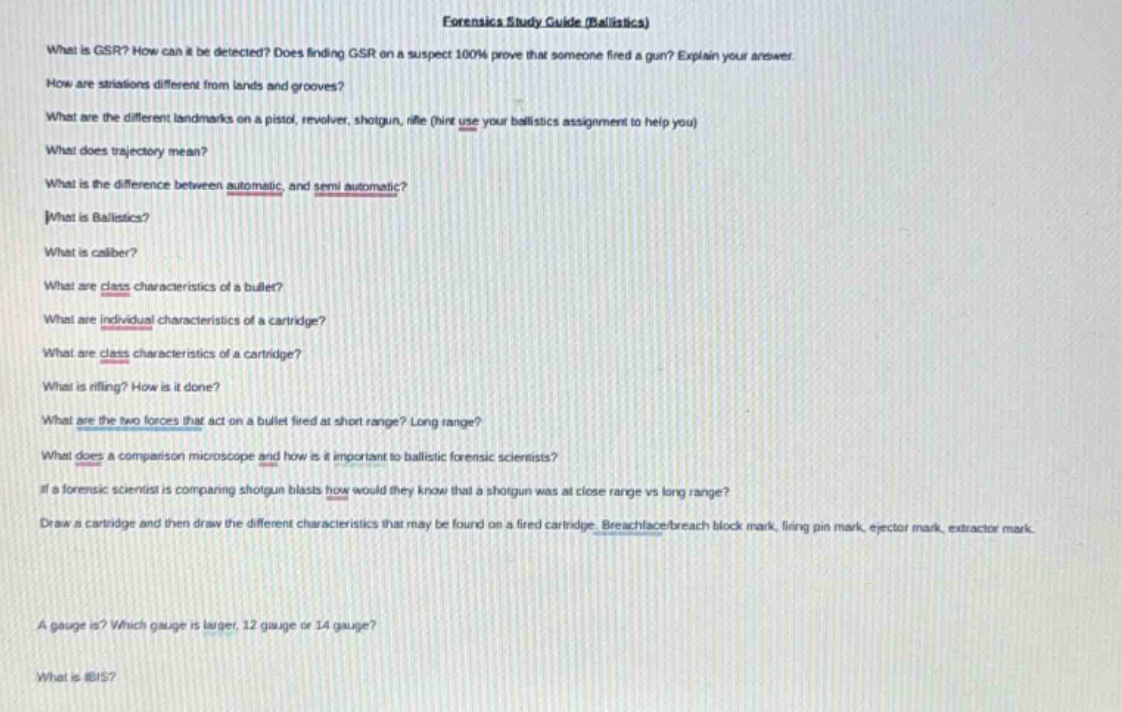
forensics study guide (ballistics)\nwhat is gsr? how can it be detected? does finding gsr on a suspect 100% prove that someone fired a gun? explain your answer.\nhow are striations different from lands and grooves?\nwhat are the different landmarks on a pistol, revolver, shotgun, rifle (hint use your ballistics assignment to help you)\nwhat does trajectory mean?\nwhat is the difference between automatic and semi - automatic?\nwhat is ballistics?\nwhat is caliber?\nwhat are class characteristics of a bullet?\nwhat are individual characteristics of a cartridge?\nwhat are class characteristics of a cartridge?\nwhat is rifling? how is it done?\nwhat are the two forces that act on a bullet fired at short range? long range?\nwhat does a comparison microscope and how is it important to ballistic forensic scientists?\nif a forensic scientist is comparing shotgun blasts how would they know that a shotgun was at close range vs long range?\ndraw a cartridge and then draw the different characteristics that may be found on a fired cartridge. breechface/breech block mark, firing pin mark, ejector mark, extractor mark.\na gauge is? which gauge is larger, 12 gauge or 14 gauge?\nwhat is ibis?
Answer
Brief Explanations:
- What is GSR? How can it be detected? Does finding GSR on a suspect 100% prove that someone fired a gun?
- GSR (Gun - Shot Residue) is a mixture of particles produced when a firearm is discharged. It can be detected using techniques like scanning electron microscopy with energy - dispersive X - ray analysis (SEM - EDS) or atomic absorption spectroscopy. Finding GSR on a suspect does not 100% prove they fired a gun as they could have been in the vicinity when a gun was fired or been contaminated in other ways.
- How are striations different from lands and grooves?
- Lands and grooves are the raised and recessed parts inside a gun barrel respectively, which impart spin to the bullet. Striations are the fine scratches on a bullet's surface caused by contact with the barrel's lands and grooves during firing.
- What are the different landmarks on a pistol, revolver, shotgun, rifle?
- Pistols have parts like the grip, trigger, slide. Revolvers have a cylinder that holds cartridges. Shotguns have a long smooth - bored barrel (usually) and a stock. Rifles have a rifled barrel, stock, and a trigger mechanism.
- What does trajectory mean?
- Trajectory is the path that a projectile (such as a bullet) follows through space from the moment it is fired until it stops.
- What is the difference between automatic and semi - automatic?
- Automatic firearms can fire multiple rounds with a single pull of the trigger as long as the trigger is held down and there are cartridges in the magazine. Semi - automatic firearms fire one round per trigger pull and automatically reload a new cartridge into the chamber.
- What is Ballistics?
- Ballistics is the science of the motion of projectiles, including the study of the firing of guns, the flight of bullets, and their impact on targets.
- What is caliber?
- Caliber is a measure of the internal diameter of a gun barrel or the diameter of a bullet. It is usually expressed in inches or millimeters.
- What are class characteristics of a bullet?
- Class characteristics of a bullet are features that are common to all bullets fired from a particular type of firearm, such as caliber, the number of lands and grooves in the barrel that fired it.
- What are individual characteristics of a cartridge?
- Individual characteristics of a cartridge are unique marks left on the cartridge case during the firing process, such as firing pin marks, ejector marks, which can be used to link a cartridge to a specific firearm.
- What are class characteristics of a cartridge?
- Class characteristics of a cartridge include the type of cartridge (e.g., caliber, rimmed or rimless), the general shape, and the dimensions that are common to cartridges of a particular type.
- What is rifling? How is it done?
- Rifling is the process of creating spiral grooves inside a gun barrel. It can be done through methods like broaching (using a broach tool), button rifling (using a hardened button to form the grooves), or hammer forging.
- What are the two forces that act on a bullet fired at short range? Long range?
- At short range, the main forces are the propulsive force from the expanding gases in the barrel and gravity. At long range, in addition to gravity, air resistance (drag) becomes a significant force that affects the bullet's trajectory.
- What does a comparison microscope and how is it important to ballistic forensic scientists?
- A comparison microscope allows two specimens (such as a test - fired bullet and a bullet from a crime scene) to be viewed side - by - side. It is important for ballistic forensic scientists to compare the microscopic markings on bullets and cartridge cases to determine if they were fired from the same firearm.
- If a forensic scientist is comparing shotgun blasts, how would they know that a shotgun was at close range vs long range?
- At close range, shotgun blasts will have a more concentrated pattern with larger wadding and shot holes in the target, and may also have powder burns or residue. At long range, the shot pattern will be more dispersed, and there will be less evidence of powder residue.
- Draw a cartridge and then draw the different characteristics that may be found on a fired cartridge.
- A cartridge has a case, primer, powder, and bullet. Fired cartridge characteristics include breach - face/breach - block mark (from contact with the firearm's breach), firing pin mark (from the firing pin hitting the primer), ejector mark (from the ejector mechanism), and extractor mark (from the extractor that removes the case from the chamber).
- What is a gauge? Which gauge is larger, 12 - gauge or 14 - gauge?
- Gauge is a measure of the size of a shotgun bore and the cartridges it fires. A lower gauge number corresponds to a larger diameter. So, 12 - gauge is larger than 14 - gauge.
- What is IBIS?
- IBIS (Integrated Ballistic Identification System) is a computer - based system used by forensic laboratories to compare the markings on fired bullets and cartridge cases to help in criminal investigations.
Answer:
- GSR is gun - shot residue, detected by SEM - EDS etc. Finding it doesn't prove firing.
- Striations are scratches, lands and grooves are barrel features.
- Different firearms have distinct parts like grip, cylinder etc.
- Trajectory is a projectile's path.
- Automatic fires multiple rounds per trigger - hold, semi - automatic one per pull.
- Ballistics is the science of projectile motion.
- Caliber is barrel or bullet diameter.
- Class bullet characteristics are common to a firearm type.
- Individual cartridge characteristics are unique firing marks.
- Class cartridge characteristics are common to a cartridge type.
- Rifling is barrel grooving, done by broaching etc.
- Short - range: propulsive and gravity; long - range: gravity and air resistance.
- Comparison microscope views specimens side - by - side for firearm comparison.
- Close range: concentrated pattern, powder burns; long range: dispersed pattern.
- Cartridge has case, primer etc. Fired has breach - face, firing pin etc. marks.
- Gauge measures shotgun bore size, 12 - gauge is larger.
- IBIS is a ballistic identification system.