four distributions, labeled (a), (b), (c), and (d) are represented below by their histograms. each…
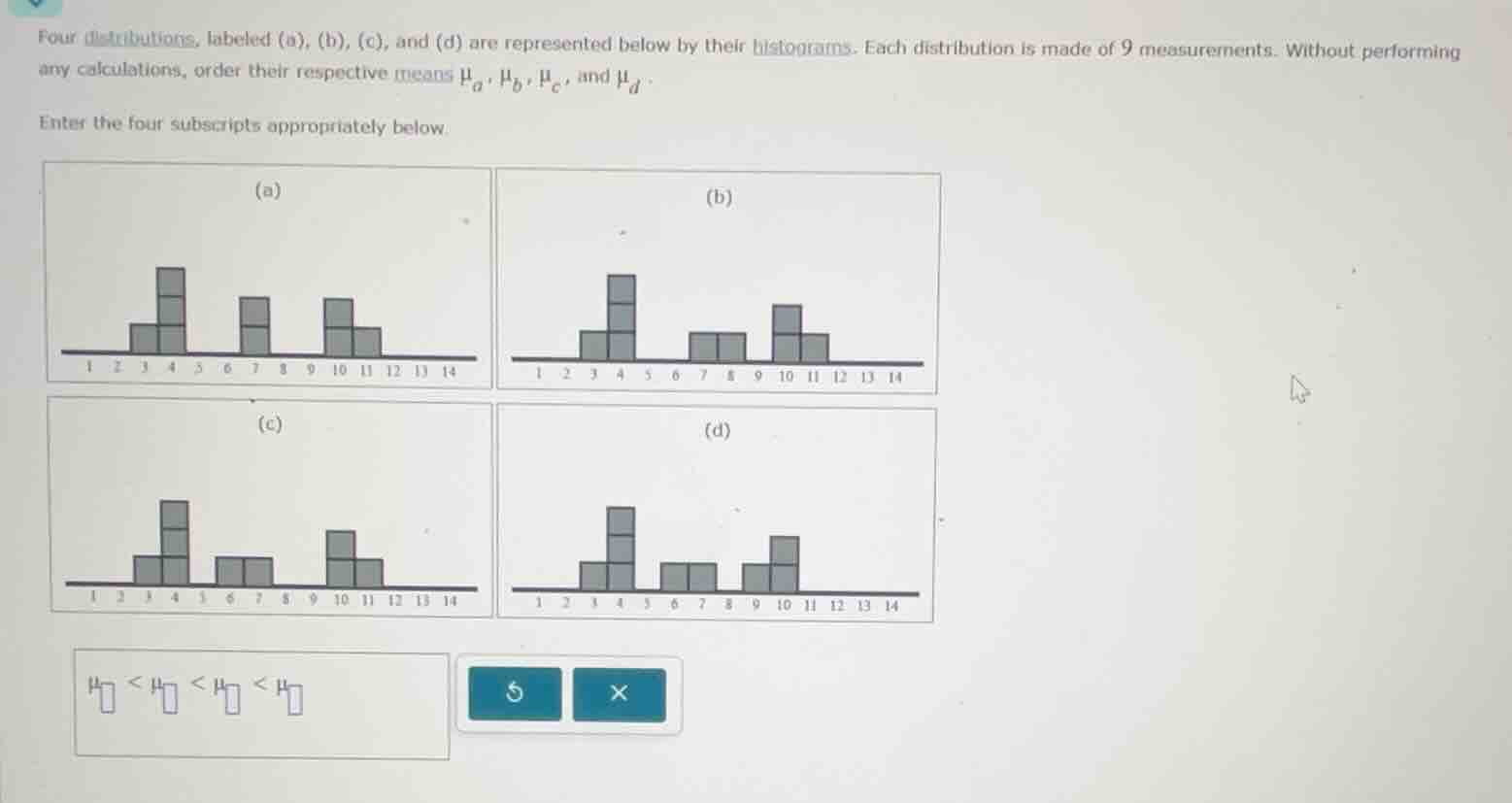
four distributions, labeled (a), (b), (c), and (d) are represented below by their histograms. each distribution is made of 9 measurements. without performing any calculations, order their respective means $\\mu_a$, $\\mu_b$, $\\mu_c$, and $\\mu_d$.\n\nenter the four subscripts appropriately below.\n\n$\\mu_{\\square} < \\mu_{\\square} < \\mu_{\\square} < \\mu_{\\square}$
Answer
Explanation:
Step1: Identify the common data points
All four distributions share the same data points at $x=3$ (1 count) and $x=4$ (3 counts).
Step2: Compare distributions (a) and (c)
Distribution (a) has points at 7, 8, 10, 11. Distribution (c) has points at 6, 7, 10, 11. Since 6 is less than 8, $\mu_c < \mu_a$.
Step3: Compare distributions (a) and (b)
Distribution (a) has points at 7, 8, 10, 11. Distribution (b) has points at 7, 8, 10, 11. They are identical, so $\mu_a = \mu_b$.
Step4: Compare distributions (c) and (d)
Distribution (c) has points at 6, 7, 10, 11. Distribution (d) has points at 6, 7, 9, 10. Since 9 and 10 are less than 10 and 11, $\mu_d < \mu_c$.
Step5: Order the means
Combining the inequalities: $\mu_d < \mu_c < \mu_a = \mu_b$.
Answer:
$\mu_d < \mu_c < \mu_a = \mu_b$ (or $\mu_d < \mu_c < \mu_b = \mu_a$)