four distributions, labeled (a), (b), (c), and (d) are represented below by their histograms. each…
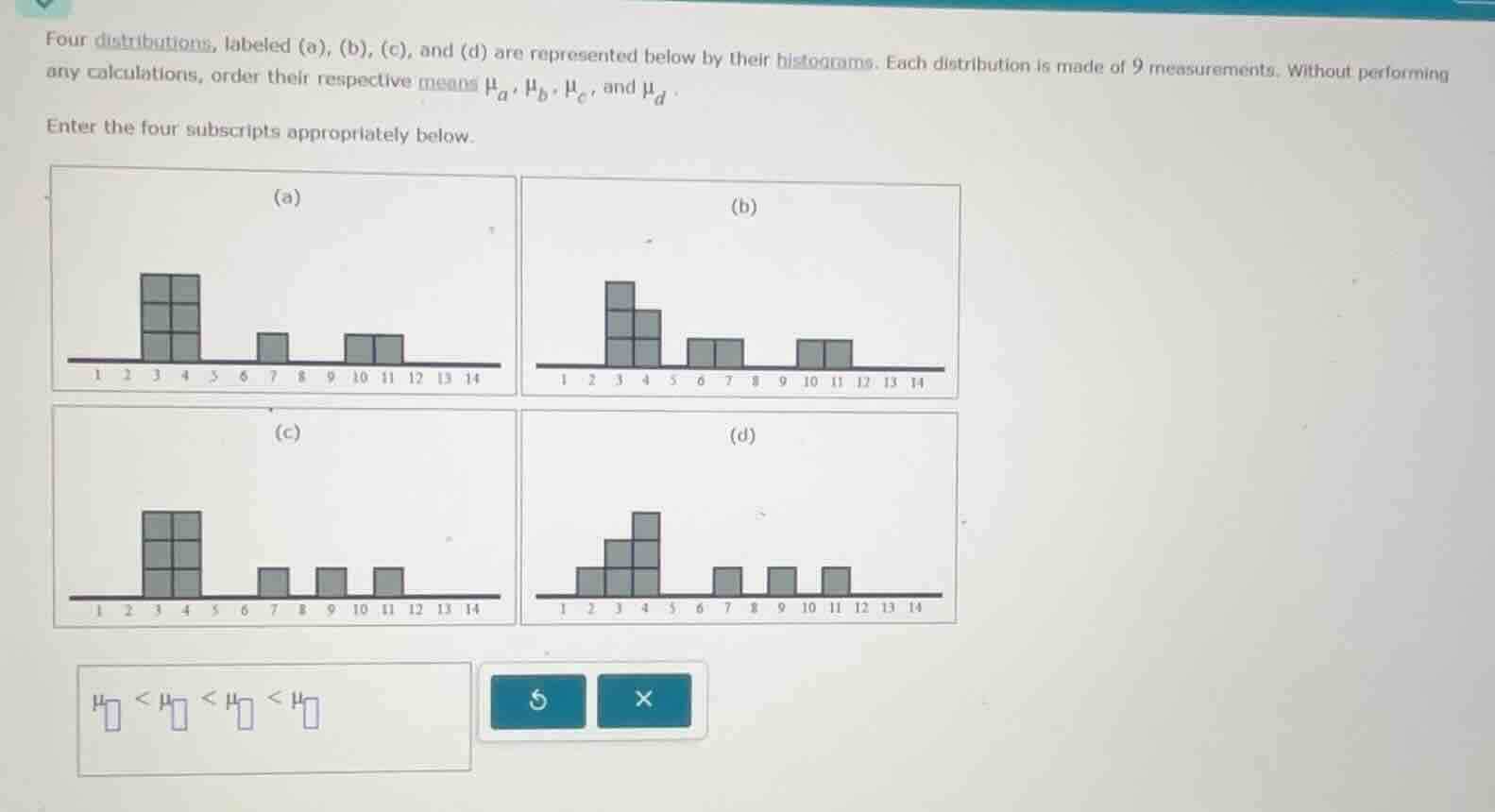
four distributions, labeled (a), (b), (c), and (d) are represented below by their histograms. each distribution is made of 9 measurements. without performing any calculations, order their respective means $\\mu_a, \\mu_b, \\mu_c$, and $\\mu_d$.\n\nenter the four subscripts appropriately below.\n\n$\\mu_{\\square} < \\mu_{\\square} < \\mu_{\\square} < \\mu_{\\square}$
Answer
Explanation:
Step1: Analyze distribution (a)
Distribution (a) has values at 3, 3, 3, 4, 4, 4, 7, 10, 11.
Step2: Analyze distribution (b)
Distribution (b) has values at 3, 3, 3, 4, 4, 6, 7, 10, 11. Compared to (a), one value moved from 4 to 6, increasing the mean.
Step3: Analyze distribution (c)
Distribution (c) has values at 3, 3, 3, 4, 4, 4, 7, 9, 11. Compared to (a), one value moved from 10 to 9, decreasing the mean.
Step4: Analyze distribution (d)
Distribution (d) has values at 2, 3, 3, 4, 4, 4, 7, 9, 11. Compared to (c), one value moved from 3 to 2, further decreasing the mean.
Step5: Order the means
Based on the shifts relative to the base distribution (a): $\mu_d < \mu_c < \mu_a < \mu_b$.
Answer:
$\mu_d < \mu_c < \mu_a < \mu_b$