francisco is playing a game with 3 green, 2 yellow, 4 red, and 3 black marbles in a bag. he has calculated…
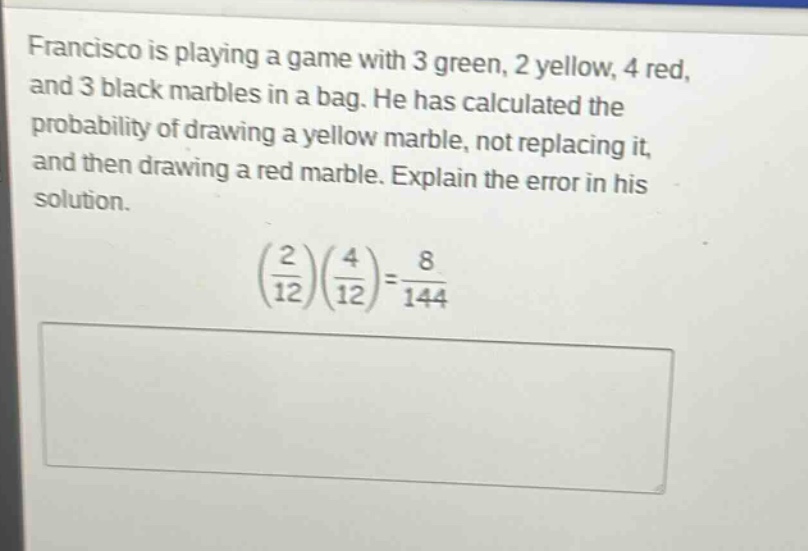
francisco is playing a game with 3 green, 2 yellow, 4 red, and 3 black marbles in a bag. he has calculated the probability of drawing a yellow marble, not replacing it, and then drawing a red marble. explain the error in his solution. (2/12)(4/12)=8/144
Answer
Explanation:
Step1: Calculate total marbles initially
The total number of marbles initially is $3 + 2+4 + 3=12$.
Step2: Analyze first - draw probability
The probability of drawing a yellow marble first is $\frac{2}{12}$ since there are 2 yellow marbles out of 12 total marbles.
Step3: Analyze second - draw probability
Since the yellow marble is not replaced, for the second draw, there are now $12 - 1 = 11$ marbles left in the bag. The probability of drawing a red marble on the second draw given that a yellow marble was drawn first is $\frac{4}{11}$, not $\frac{4}{12}$.
Step4: Identify error
Francisco's error was using 12 as the denominator for the second - draw probability instead of 11, since the first marble was not replaced.
Answer:
Francisco used 12 as the denominator for the second - draw probability instead of 11. Since the first yellow marble was not replaced, there are 11 marbles left for the second draw, not 12.