franco has a hat with 9 blue marbles, 4 yellow marbles, and 12 green marbles. he designs a binomial…
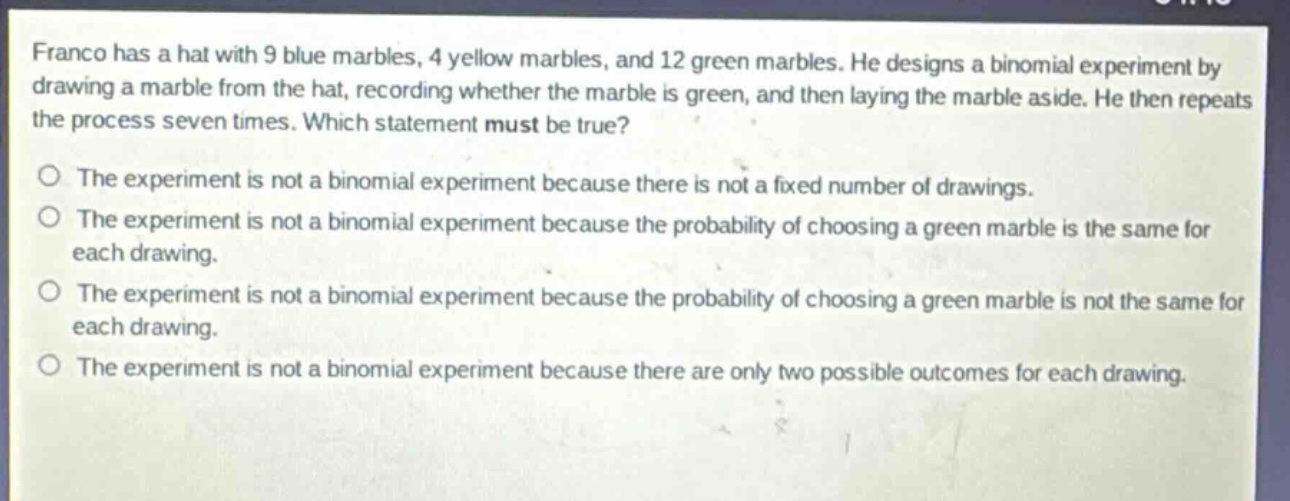
franco has a hat with 9 blue marbles, 4 yellow marbles, and 12 green marbles. he designs a binomial experiment by drawing a marble from the hat, recording whether the marble is green, and then laying the marble aside. he then repeats the process seven times. which statement must be true?\nthe experiment is not a binomial experiment because there is not a fixed number of drawings.\nthe experiment is not a binomial experiment because the probability of choosing a green marble is the same for each drawing.\nthe experiment is not a binomial experiment because the probability of choosing a green marble is not the same for each drawing.\nthe experiment is not a binomial experiment because there are only two possible outcomes for each drawing.
Answer
Explanation:
Step1: Recall binomial experiment conditions
A binomial experiment has the following conditions:
- A fixed number of trials ((n)).
- Each trial has only two possible outcomes (success or failure).
- The probability of success ((p)) is the same for each trial.
- The trials are independent.
In this case, the number of trials (n = 7) (fixed). The two outcomes are "green marble" (success) and "non - green marble" (failure). But since the marble is laid aside (not replaced), the probability of choosing a green marble changes for each drawing.
For example, initially, the total number of marbles (N=9 + 4+12=25), and the probability of choosing a green marble (p_1=\frac{12}{25}). After the first draw (if it's green, the number of green marbles becomes (11) and the total number of marbles becomes (24)), so (p_2=\frac{11}{24}) (if the first marble was green).
Step2: Analyze each option
- Option 1: The number of drawings (n = 7) is fixed. So this option is wrong.
- Option 2: If the probability of choosing a green marble is the same for each drawing (which is not the case here as marbles are not replaced), it would be a binomial experiment. But the fact that the probability is the same is not the reason it's not a binomial experiment. Also, in our case, the probability is not the same. So this option is wrong.
- Option 3: Since marbles are not replaced, the probability of choosing a green marble ((P(\text{green}))) changes for each drawing. This violates the "constant probability of success" condition of a binomial experiment. So this option is correct.
- Option 4: Having two possible outcomes (green or non - green) is a requirement of a binomial experiment. So this option is wrong.
Answer:
The experiment is not a binomial experiment because the probability of choosing a green marble is not the same for each drawing.