fredrick hit 14, 18, 13, 12, 12, 16, 13, 12, 1, and 15 home runs in 10 seasons of play. which statements are…
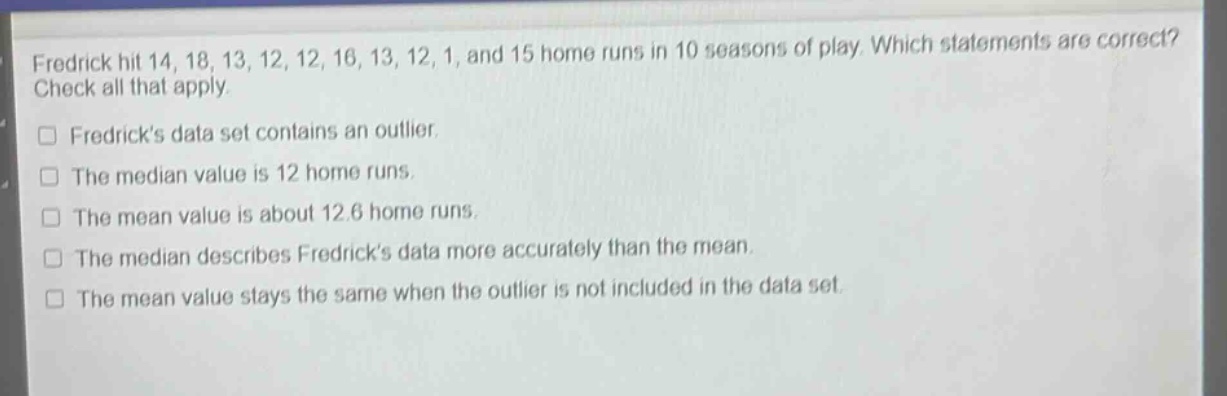
fredrick hit 14, 18, 13, 12, 12, 16, 13, 12, 1, and 15 home runs in 10 seasons of play. which statements are correct? check all that apply.\n□ fredricks data set contains an outlier.\n□ the median value is 12 home runs.\n□ the mean value is about 12.6 home runs.\n□ the median describes fredricks data more accurately than the mean.\n□ the mean value stays the same when the outlier is not included in the data set.
Answer
Explanation:
Step1: Arrange data in ascending order
$1, 12, 12, 12, 13, 13, 14, 15, 16, 18$
Step2: Check for outlier
The value $1$ is far - from other values, so there is an outlier.
Step3: Calculate median
There are $n = 10$ data points. Median is the average of the $\frac{n}{2}$th and $(\frac{n}{2}+1)$th ordered values. $\frac{10}{2}=5$ and $\frac{10}{2}+1 = 6$. Median$=\frac{13 + 13}{2}=13$.
Step4: Calculate mean
Mean$=\frac{1+12+12+12+13+13+14+15+16+18}{10}=\frac{126}{10}=12.6$
Step5: Analyze median and mean
Since there is an outlier ($1$), the median ($13$) is less affected by the outlier and describes the data more accurately than the mean ($12.6$).
Step6: Calculate mean without outlier
New data set: $12, 12, 12, 13, 13, 14, 15, 16, 18$. Mean$=\frac{12+12+12+13+13+14+15+16+18}{9}=\frac{125}{9}\approx13.9$, mean changes.
Answer:
Fredrick's data set contains an outlier. The mean value is about 12.6 home runs. The median describes Fredrick's data more accurately than the mean.