all freshmen, sophomores, juniors, and seniors attended a high school assembly. the total student attendance…
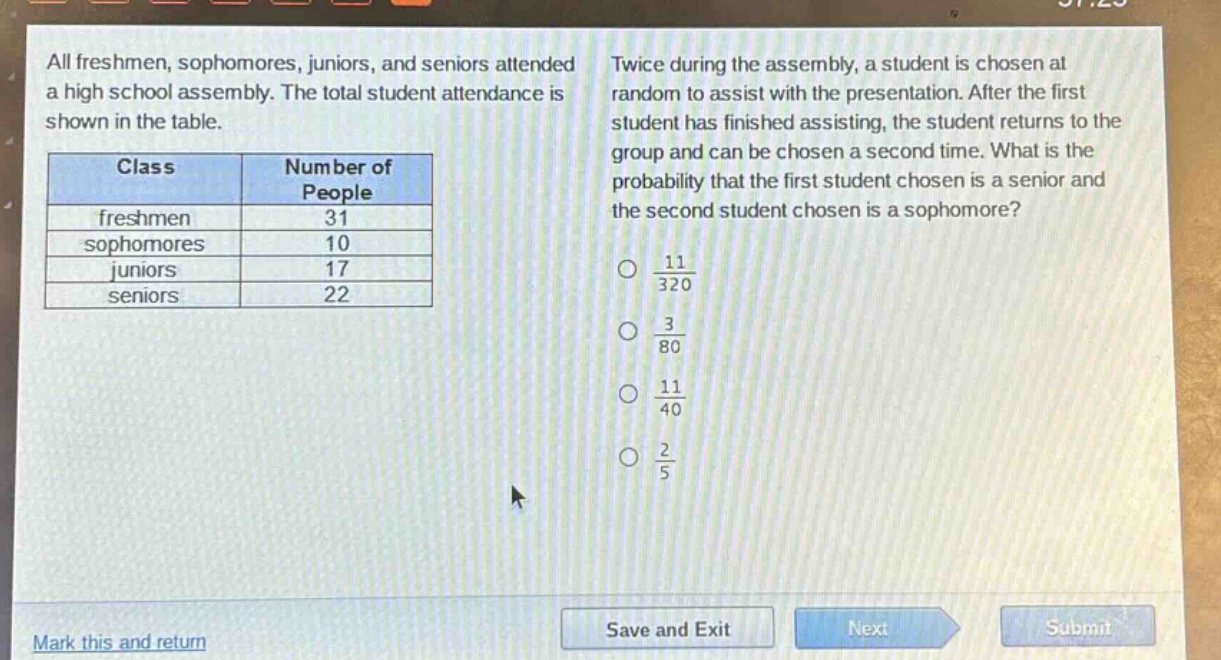
all freshmen, sophomores, juniors, and seniors attended a high school assembly. the total student attendance is shown in the table.\n| class | number of people |\n| ---- | ---- |\n| freshmen | 31 |\n| sophomores | 10 |\n| juniors | 17 |\n| seniors | 22 |\ntwice during the assembly, a student is chosen at random to assist with the presentation. after the first student has finished assisting, the student returns to the group and can be chosen a second time. what is the probability that the first student chosen is a senior and the second student chosen is a sophomore?\n○ $\frac{11}{320}$\n○ $\frac{3}{80}$\n○ $\frac{11}{40}$\n○ $\frac{2}{5}$
Answer
Explanation:
Step1: Calculate total number of students
$31 + 10+17 + 22=80$
Step2: Calculate probability of first - student being a senior
The probability $P(\text{senior})$ that the first student chosen is a senior is the number of seniors divided by the total number of students. So $P(\text{senior})=\frac{22}{80}$
Step3: Calculate probability of second - student being a sophomore
Since the first student is replaced, the total number of students is still 80. The probability $P(\text{sophomore})$ that the second student chosen is a sophomore is the number of sophomores divided by the total number of students. So $P(\text{sophomore})=\frac{10}{80}$
Step4: Calculate the combined probability
Since the two events are independent (because the first student is replaced), the probability that the first student is a senior and the second student is a sophomore is the product of the two probabilities. $P = P(\text{senior})\times P(\text{sophomore})=\frac{22}{80}\times\frac{10}{80}=\frac{22\times10}{80\times80}=\frac{220}{6400}=\frac{11}{320}$
Answer:
$\frac{11}{320}$