a fuel pump at a gasoline station doesnt always dispense the exact amount displayed on the meter. when the…
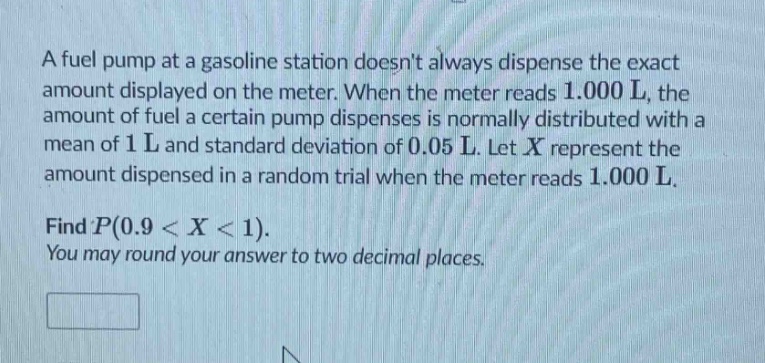
a fuel pump at a gasoline station doesnt always dispense the exact amount displayed on the meter. when the meter reads 1.000 l, the amount of fuel a certain pump dispenses is normally distributed with a mean of 1 l and standard deviation of 0.05 l. let (x) represent the amount dispensed in a random trial when the meter reads 1.000 l. find (p(0.9 < x < 1)). you may round your answer to two decimal places.
Answer
Explanation:
Step1: Standardize the bounds
We use the formula $Z=\frac{X - \mu}{\sigma}$, where $\mu = 1$, $\sigma=0.05$. For $x = 0.9$, $z_1=\frac{0.9 - 1}{0.05}=\frac{- 0.1}{0.05}=-2$. For $x = 1$, $z_2=\frac{1 - 1}{0.05}=0$.
Step2: Use the standard - normal distribution table
We know that $P(0.9<X<1)=P(-2 < Z < 0)$. Since the standard - normal distribution table gives $P(Z < z)$, and $P(-2 < Z < 0)=P(Z < 0)-P(Z < - 2)$. From the standard - normal table, $P(Z < 0)=0.5$ and $P(Z < - 2)=0.0228$.
Step3: Calculate the probability
$P(-2 < Z < 0)=0.5 - 0.0228 = 0.4772\approx0.48$.
Answer:
$0.48$