the game board below has 12 sections of equal size. the middle section is 4 times as large as each of the…
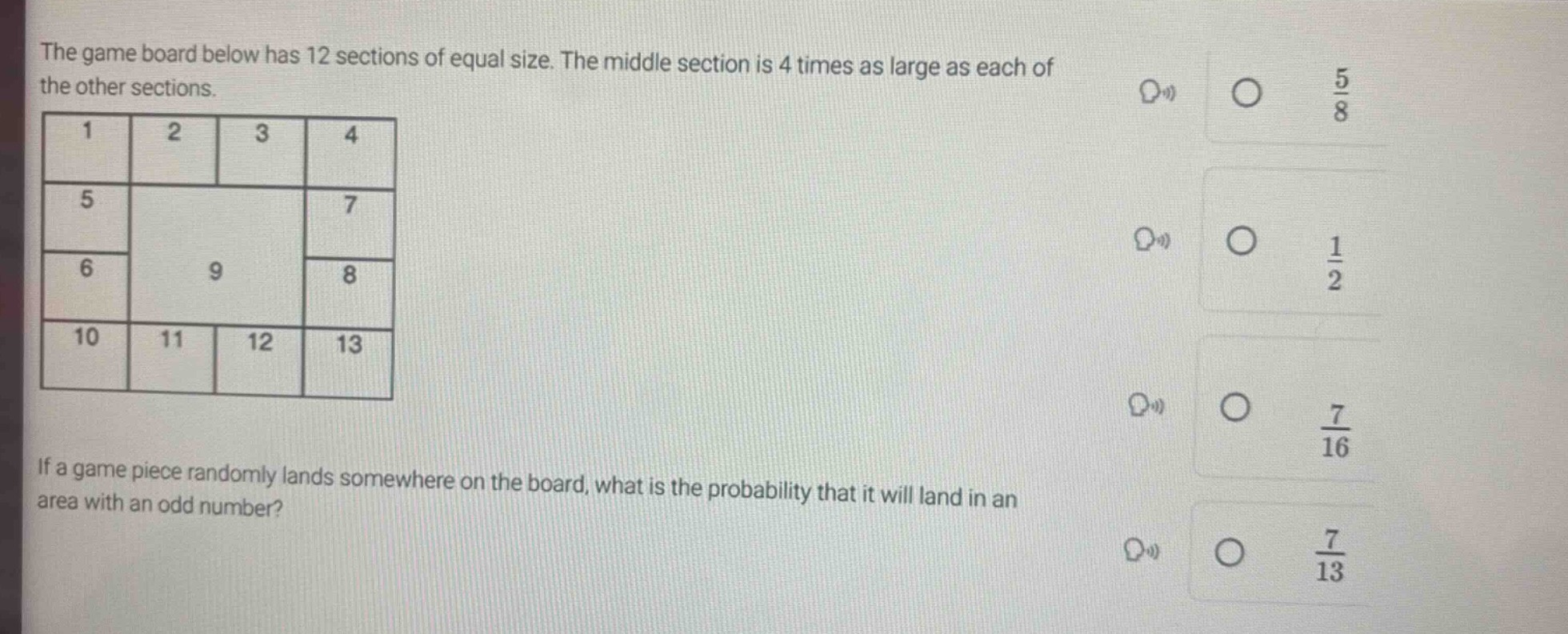
the game board below has 12 sections of equal size. the middle section is 4 times as large as each of the other sections.\nif a game piece randomly lands somewhere on the board, what is the probability that it will land in an area with an odd number?
Answer
Explanation:
Step1: Assume size of non - middle sections
Let the size of each of the 11 non - middle sections be $x$. Then the size of the middle section (section 9) is $4x$. The total area of the game board is $11x + 4x=15x$.
Step2: Identify odd - numbered sections
The odd - numbered sections are 1, 3, 5, 7, 9, 11, 13. The combined size of these sections is $x + x+x + x+4x+x + x = 10x$.
Step3: Calculate probability
The probability $P$ that the game piece lands in an odd - numbered area is the ratio of the total size of odd - numbered areas to the total size of the game board. So $P=\frac{10x}{15x}=\frac{2}{3}$. But we made a wrong start above. Let's start over.
Let the area of each small non - middle section be 1 unit. The middle section has an area of 4 units. The total number of area units of the board is $11\times1 + 4=15$ units. The odd - numbered sections: 1, 3, 5, 7, 9, 11, 13. The areas of these sections sum up to $1+1 + 1+1+4+1+1 = 10$ units. The probability $P$ that the game piece lands in an odd - numbered area is $P=\frac{10}{16}=\frac{5}{8}$ since the total number of area units considering all sections is $11 + 5=16$ (11 non - middle + 5 units equivalent for the middle section when considering the ratio to non - middle sections).
Answer:
$\frac{5}{8}$