in a game of darts, there are 20 sectors on a target, and a smaller circular \bullseye\ in the center. in…
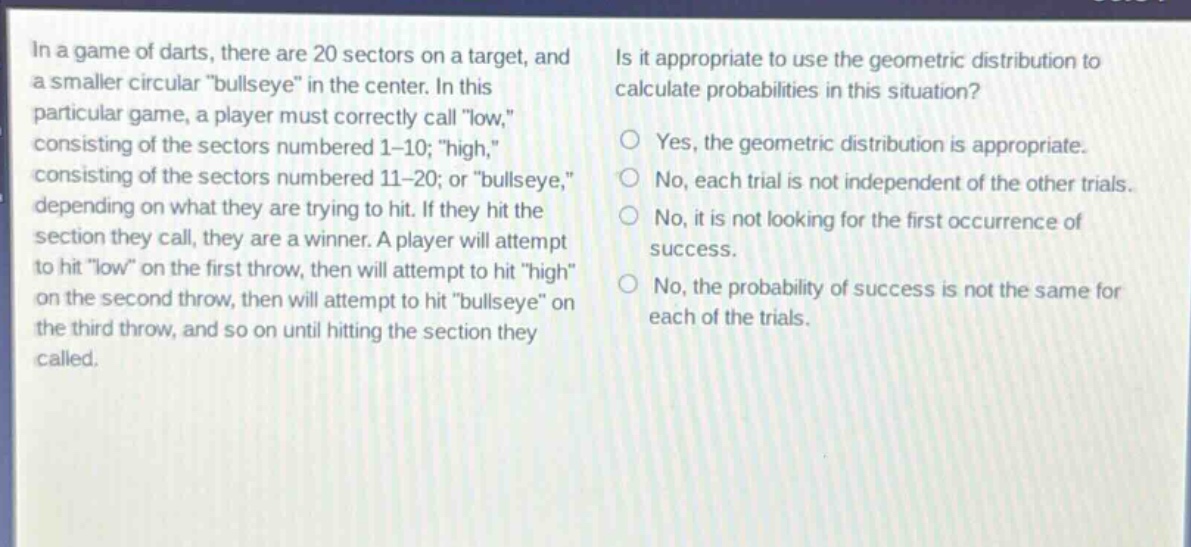
in a game of darts, there are 20 sectors on a target, and a smaller circular \bullseye\ in the center. in this particular game, a player must correctly call \low,\, consisting of the sectors numbered 1 - 10; \high,\, consisting of the sectors numbered 11 - 20; or \bullseye,\, depending on what they are trying to hit. if they hit the section they call, they are a winner. a player will attempt to hit \low\ on the first throw, then will attempt to hit \high\ on the second throw, then will attempt to hit \bullseye\ on the third throw, and so on until hitting the section they called. is it appropriate to use the geometric distribution to calculate probabilities in this situation? yes, the geometric distribution is appropriate. no, each trial is not independent of the other trials. no, it is not looking for the first occurrence of success. no, the probability of success is not the same for each of the trials.
Answer
Brief Explanations:
The geometric - distribution has three main requirements: independent trials, constant probability of success for each trial, and looking for the first occurrence of success. In this darts - throwing situation, the probability of success is different for each trial (probability of hitting "low" is $\frac{10}{20}$, probability of hitting "high" is $\frac{10}{20}$, and probability of hitting "bullseye" is $\frac{1}{20}$).
Answer:
No, the probability of success is not the same for each of the trials.