a game involves rolling a number cube. you get one point if you roll an even number and negative one point…
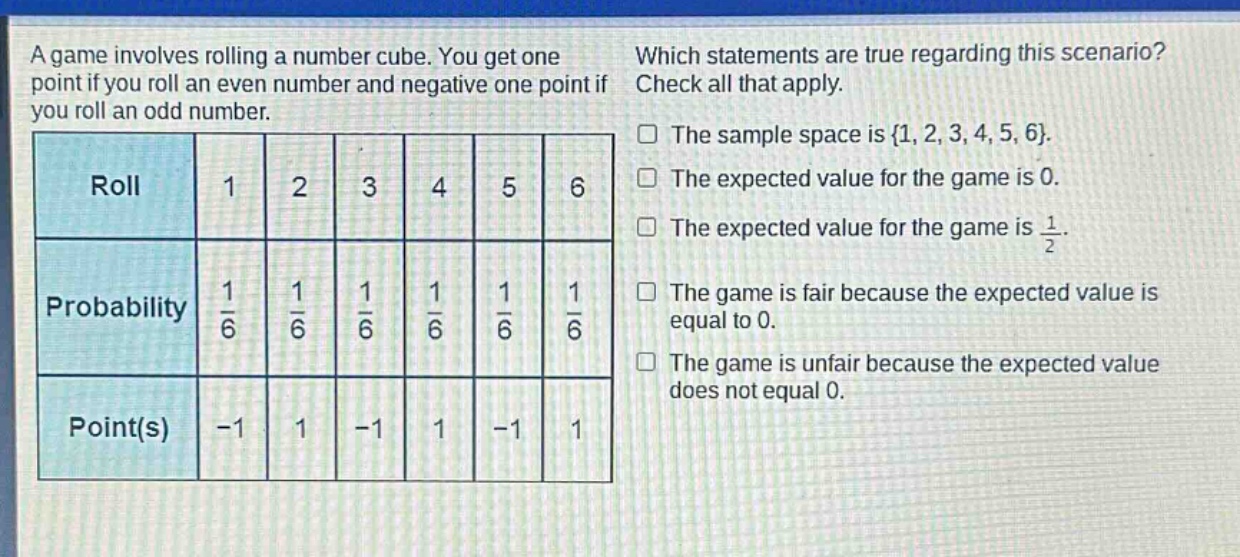
a game involves rolling a number cube. you get one point if you roll an even number and negative one point if you roll an odd number. which statements are true regarding this scenario? check all that apply. roll 1 2 3 4 5 6 probability $\frac{1}{6}$ $\frac{1}{6}$ $\frac{1}{6}$ $\frac{1}{6}$ $\frac{1}{6}$ $\frac{1}{6}$ point(s) -1 1 -1 1 -1 1 the sample space is {1, 2, 3, 4, 5, 6}. the expected value for the game is 0. the expected value for the game is $\frac{1}{2}$. the game is fair because the expected value is equal to 0. the game is unfair because the expected value does not equal 0.
Answer
Answer:
- The sample space is {1, 2, 3, 4, 5, 6}.
- The expected value for the game is 0.
- The game is fair because the expected value is equal to 0.
Explanation:
Step1: Define sample space
The sample space of rolling a number - cube is all possible outcomes, which is {1, 2, 3, 4, 5, 6}.
Step2: Calculate expected value formula
The formula for expected value $E(X)=\sum_{i = 1}^{n}x_ip_i$, where $x_i$ is the outcome value and $p_i$ is the probability of the outcome.
Step3: Calculate expected value
$E(X)=(- 1)\times\frac{3}{6}+1\times\frac{3}{6}=-\frac{3}{6}+\frac{3}{6}=0$. Here, there are 3 odd numbers (1, 3, 5) with a value of - 1 and probability $\frac{1}{6}$ each, and 3 even numbers (2, 4, 6) with a value of 1 and probability $\frac{1}{6}$ each.
Step4: Determine fairness
A game is fair if the expected value is 0. Since $E(X) = 0$, the game is fair.