a game is played by rolling balls up a ramp into holes of various point values. a player believes that her…
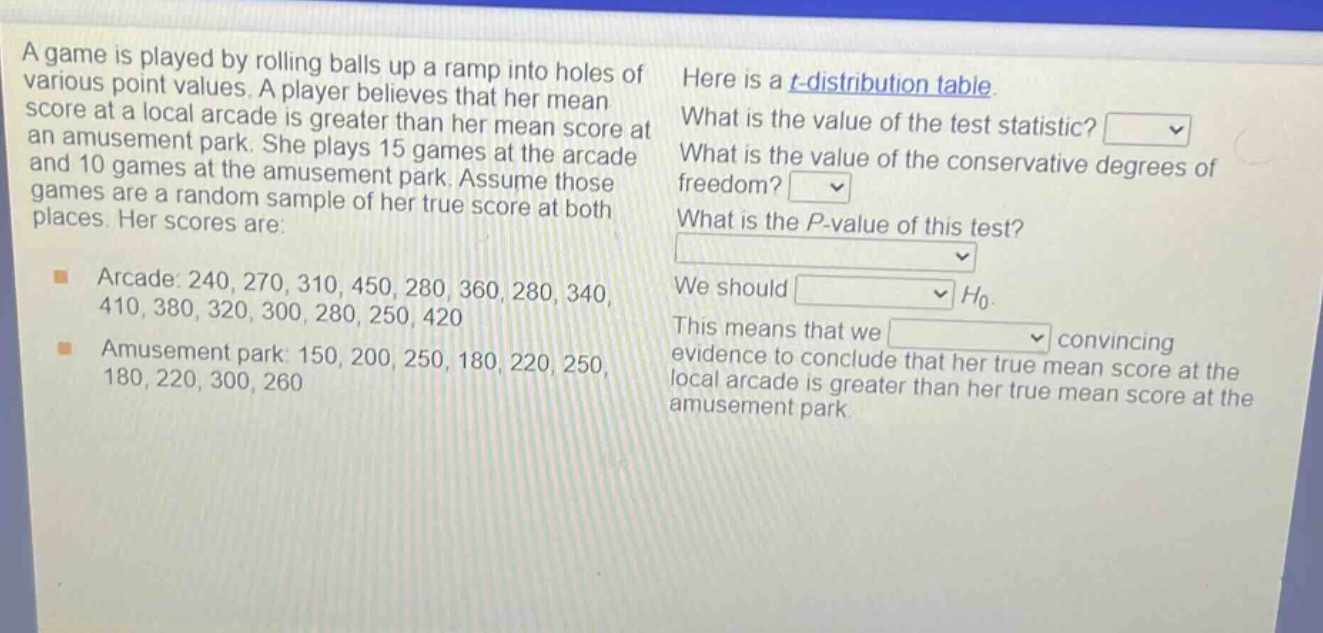
a game is played by rolling balls up a ramp into holes of various point values. a player believes that her mean score at a local arcade is greater than her mean score at an amusement park. she plays 15 games at the arcade and 10 games at the amusement park. assume those games are a random sample of her true score at both places. her scores are: arcade: 240, 270, 310, 450, 280, 360, 280, 340, 410, 380, 320, 300, 280, 250, 420 amusement park: 150, 200, 250, 180, 220, 250, 180, 220, 300, 260 here is a t -distribution table. what is the value of the test statistic? what is the value of the conservative degrees of freedom? what is the p -value of this test? we should h0. this means that we convincing evidence to conclude that her true mean score at the local arcade is greater than her true mean score at the amusement park.
Answer
Explanation:
Step1: Calculate sample means
Let $x_1$ be scores at arcade and $x_2$ be scores at amusement - park. $n_1 = 15$, $\sum_{i = 1}^{15}x_{1i}=240 + 270+\cdots+420 = 4610$, so $\bar{x}1=\frac{\sum{i = 1}^{15}x_{1i}}{n_1}=\frac{4610}{15}\approx307.33$. $n_2 = 10$, $\sum_{i = 1}^{10}x_{2i}=150 + 200+\cdots+260 = 2010$, so $\bar{x}2=\frac{\sum{i = 1}^{10}x_{2i}}{n_2}=\frac{2010}{10}=201$.
Step2: Calculate sample variances
$s_1^2=\frac{\sum_{i = 1}^{15}(x_{1i}-\bar{x}1)^2}{n_1 - 1}$, $\sum{i = 1}^{15}(x_{1i}-\bar{x}1)^2=(240 - 307.33)^2+(270 - 307.33)^2+\cdots+(420 - 307.33)^2\approx19796.67$, $s_1^2=\frac{19796.67}{14}\approx1414.05$. $s_2^2=\frac{\sum{i = 1}^{10}(x_{2i}-\bar{x}2)^2}{n_2 - 1}$, $\sum{i = 1}^{10}(x_{2i}-\bar{x}_2)^2=(150 - 201)^2+(200 - 201)^2+\cdots+(260 - 201)^2\approx14990$, $s_2^2=\frac{14990}{9}\approx1665.56$.
Step3: Calculate the test - statistic
The formula for the two - sample t - test statistic (unequal variances) is $t=\frac{\bar{x}_1-\bar{x}_2}{\sqrt{\frac{s_1^2}{n_1}+\frac{s_2^2}{n_2}}}$. $t=\frac{307.33 - 201}{\sqrt{\frac{1414.05}{15}+\frac{1665.56}{10}}}=\frac{106.33}{\sqrt{94.27+166.56}}=\frac{106.33}{\sqrt{260.83}}\approx\frac{106.33}{16.15}\approx6.58$.
Step4: Calculate the conservative degrees of freedom
The conservative degrees of freedom is $df=\min(n_1 - 1,n_2 - 1)=\min(15 - 1,10 - 1)=9$.
Step5: Calculate the P - value
Since this is a one - tailed test ($H_1:\mu_1>\mu_2$) with $df = 9$ and $t\approx6.58$, using a t - distribution table or calculator, the P - value is very small (close to 0).
Step6: Make a decision
Let's assume a significance level $\alpha = 0.05$. Since the P - value is less than $\alpha$, we reject $H_0$. This means that we have convincing evidence to conclude that her true mean score at the local arcade is greater than her true mean score at the amusement park.
Answer:
Test statistic: approximately $6.58$ Degrees of freedom: $9$ P - value: close to $0$ Decision: Reject $H_0$ Conclusion: have convincing evidence