generating the next value\na basketball player recorded her points for 11 consecutive games. her points are…
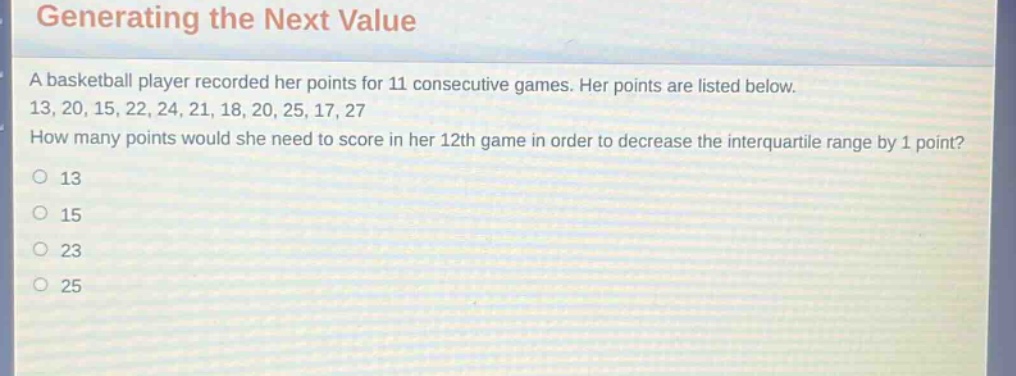
generating the next value\na basketball player recorded her points for 11 consecutive games. her points are listed below.\n13, 20, 15, 22, 24, 21, 18, 20, 25, 17, 27\nhow many points would she need to score in her 12th game in order to decrease the interquartile range by 1 point?\n13\n15\n23\n25
Answer
Explanation:
Step1: Arrange data in ascending order
13, 15, 17, 18, 20, 20, 21, 22, 24, 25, 27
Step2: Find the median (Q2) of the 11 - data set
Since (n = 11), the median is the (\left(\frac{n + 1}{2}\right))-th value. (\frac{11+1}{2}=6)-th value, so (Q2 = 20).
Step3: Find Q1 and Q3 of the 11 - data set
The lower half is 13, 15, 17, 18, 20. The median of the lower half ((Q1)) is 17. The upper half is 21, 22, 24, 25, 27. The median of the upper half ((Q3)) is 24. The inter - quartile range (IQR_1=Q3 - Q1=24 - 17 = 7).
Step4: Consider adding a new data - point
Let the new data - point be (x). We want (IQR_2=6). We need to consider different cases of adding (x) to the data set and re - calculating the quartiles. If we add (x = 15): The new data set in ascending order is 13, 15, 15, 17, 18, 20, 20, 21, 22, 24, 25, 27. Since (n = 12), the median (Q2=\frac{20 + 20}{2}=20). The lower half is 13, 15, 15, 17, 18, 20. (Q1=\frac{15+17}{2}=16). The upper half is 20, 21, 22, 24, 25, 27. (Q3=\frac{22 + 24}{2}=23). (IQR=Q3 - Q1=23 - 16 = 7) (not correct). If (x = 13): The new data set in ascending order is 13, 13, 15, 17, 18, 20, 20, 21, 22, 24, 25, 27. Since (n = 12), (Q2=\frac{20 + 20}{2}=20). The lower half is 13, 13, 15, 17, 18, 20. (Q1=\frac{15+17}{2}=16). The upper half is 20, 21, 22, 24, 25, 27. (Q3=\frac{22 + 24}{2}=23). (IQR = 23-16=7) (not correct). If (x = 23): The new data set in ascending order is 13, 15, 17, 18, 20, 20, 21, 22, 23, 24, 25, 27. Since (n = 12), (Q2=\frac{20 + 21}{2}=20.5). The lower half is 13, 15, 17, 18, 20, 20. (Q1=\frac{17+18}{2}=17.5). The upper half is 21, 22, 23, 24, 25, 27. (Q3=\frac{23+24}{2}=23.5). (IQR=23.5 - 17.5 = 6). If (x = 25): The new data set in ascending order is 13, 15, 17, 18, 20, 20, 21, 22, 24, 25, 25, 27. Since (n = 12), (Q2=\frac{21 + 22}{2}=21.5). The lower half is 13, 15, 17, 18, 20, 20. (Q1=\frac{17+18}{2}=17.5). The upper half is 22, 24, 25, 25, 27. (Q3=\frac{24+25}{2}=24.5). (IQR=24.5 - 17.5 = 7) (not correct).
Answer:
C. 23