for the given situation, find the specified confidence interval for the population proportion.\n1. in a…
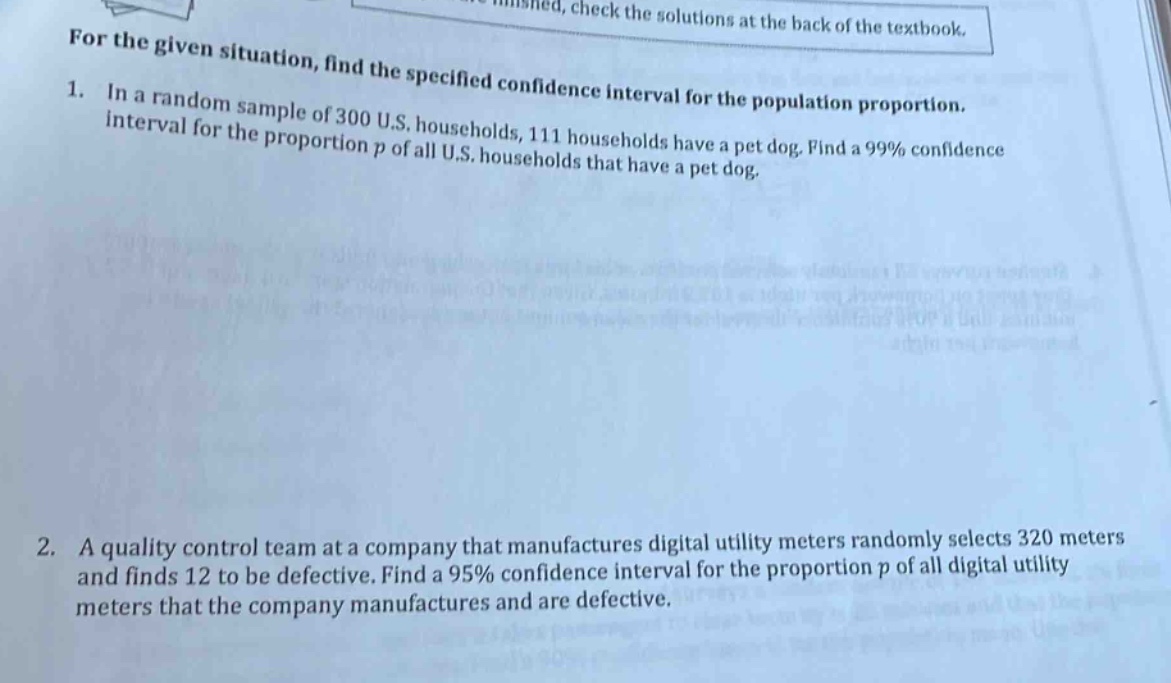
for the given situation, find the specified confidence interval for the population proportion.\n1. in a random sample of 300 u.s. households, 111 households have a pet dog. find a 99% confidence interval for the proportion p of all u.s. households that have a pet dog.\n2. a quality control team at a company that manufactures digital utility meters randomly selects 320 meters and finds 12 to be defective. find a 95% confidence interval for the proportion p of all digital utility meters that the company manufactures and are defective.
Answer
Explanation:
Step1: Calculate sample proportion $\hat{p}$ for first - case
The sample proportion $\hat{p}=\frac{x}{n}$, where $x$ is the number of successes and $n$ is the sample size. For the first problem, $n = 300$ and $x=111$. So, $\hat{p}=\frac{111}{300}=0.37$.
Step2: Find $z$-value for 99% confidence interval
For a 99% confidence interval, the significance level $\alpha=1 - 0.99 = 0.01$, and $\alpha/2=0.005$. The $z$-value $z_{\alpha/2}=z_{0.005}=2.576$.
Step3: Calculate the margin of error $E$
The formula for the margin of error for a proportion is $E = z_{\alpha/2}\sqrt{\frac{\hat{p}(1 - \hat{p})}{n}}$. Substituting $\hat{p}=0.37$, $n = 300$, and $z_{\alpha/2}=2.576$, we get $E=2.576\sqrt{\frac{0.37\times(1 - 0.37)}{300}}=2.576\sqrt{\frac{0.37\times0.63}{300}}\approx2.576\times0.0279\approx0.072$.
Step4: Calculate the confidence interval
The confidence interval for a proportion is $\hat{p}-E<p<\hat{p} + E$. So, $0.37-0.072 < p<0.37 + 0.072$, which is $0.298 < p<0.442$.
Step5: Calculate sample proportion $\hat{p}$ for second - case
For the second problem, $n = 320$ and $x = 12$. So, $\hat{p}=\frac{12}{320}=0.0375$.
Step6: Find $z$-value for 95% confidence interval
For a 95% confidence interval, $\alpha=1 - 0.95=0.05$, and $\alpha/2 = 0.025$. The $z$-value $z_{\alpha/2}=z_{0.025}=1.96$.
Step7: Calculate the margin of error $E$
Using the formula $E=z_{\alpha/2}\sqrt{\frac{\hat{p}(1 - \hat{p})}{n}}$, substituting $\hat{p}=0.0375$, $n = 320$, and $z_{\alpha/2}=1.96$, we get $E=1.96\sqrt{\frac{0.0375\times(1 - 0.0375)}{320}}=1.96\sqrt{\frac{0.0375\times0.9625}{320}}\approx1.96\times0.0106\approx0.021$.
Step8: Calculate the confidence interval
The confidence interval is $\hat{p}-E<p<\hat{p}+E$. So, $0.0375-0.021 < p<0.0375 + 0.021$, which is $0.0165 < p<0.0585$.
Answer:
- The 99% confidence interval for the proportion of all U.S. households that have a pet dog is $(0.298,0.442)$.
- The 95% confidence interval for the proportion of all digital utility meters that are defective is $(0.0165,0.0585)$.