a grading scale is set up for 1000 students test scores. it assumes the scores are normally distributed with…
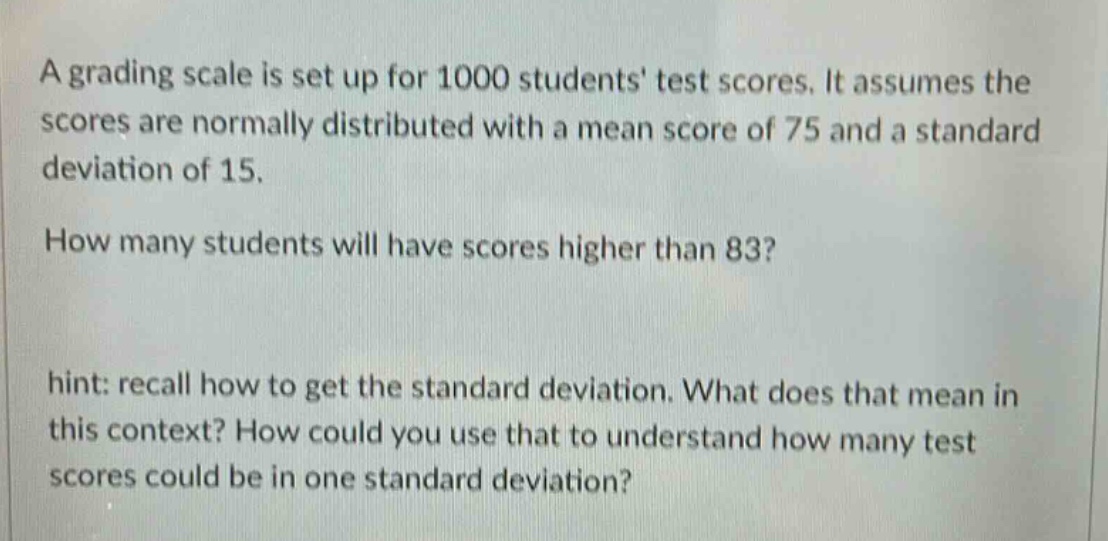
a grading scale is set up for 1000 students test scores. it assumes the scores are normally distributed with a mean score of 75 and a standard deviation of 15.\nhow many students will have scores higher than 83?\nhint: recall how to get the standard deviation. what does that mean in this context? how could you use that to understand how many test scores could be in one standard deviation?
Answer
Explanation:
Step1: Calculate the z - score
The z - score formula is $z=\frac{x-\mu}{\sigma}$, where $x = 83$, $\mu=75$, and $\sigma = 15$. $z=\frac{83 - 75}{15}=\frac{8}{15}\approx0.53$
Step2: Find the proportion of scores below 83
Using a standard normal distribution table (or z - table), the proportion of scores with a z - score of 0.53 is approximately 0.7019.
Step3: Find the proportion of scores above 83
The proportion of scores above 83 is $1 - 0.7019=0.2981$.
Step4: Calculate the number of students
Multiply the proportion by the total number of students. There are 1000 students, so the number of students with scores higher than 83 is $0.2981\times1000 = 298.1\approx298$.
Answer:
298