the graph shows a probability distribution. what is p(x < 3)? 0.125 0.25 0.75 0.875
the graph shows a probability distribution. what is p(x < 3)? 0.125 0.25 0.75 0.875
Answer
Explanation:
Step1: Recall probability - area relationship
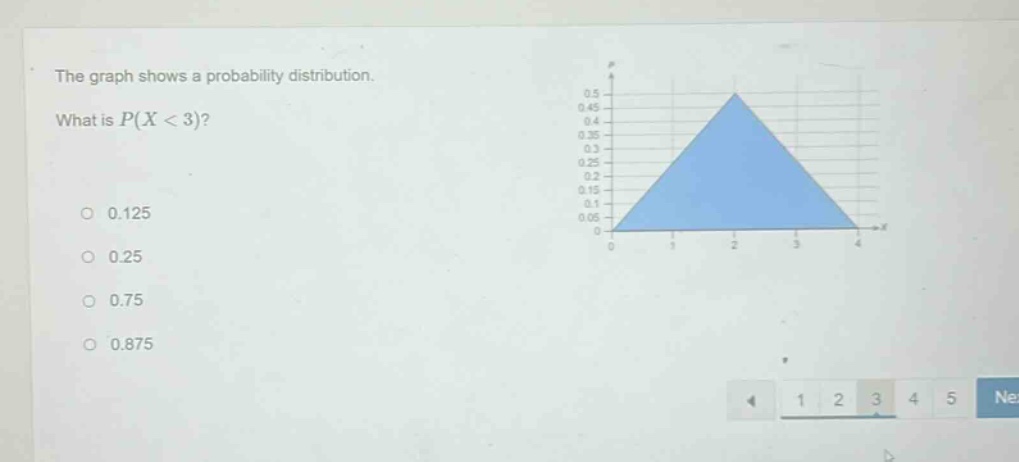
The probability $P(X < 3)$ is the area under the probability - distribution curve to the left of $x = 3$. The probability - distribution is a triangle with base $b$ and height $h$. The area of a triangle is $A=\frac{1}{2}bh$.
Step2: Determine the base and height of the sub - triangle
The entire triangle of the probability distribution has a base from $x = 0$ to $x = 4$ (so $b_{total}=4$) and a height of $h = 0.5$. The sub - triangle for $P(X < 3)$ has a base $b = 3$ and height $h = 0.5\times\frac{3}{4}=0.375$ (since the height of the sub - triangle is proportional to its base within the larger triangle).
Step3: Calculate the area of the sub - triangle
Using the area formula for a triangle $A=\frac{1}{2}bh$, with $b = 3$ and $h = 0.375$, we have $A=\frac{1}{2}\times3\times0.375=\frac{3\times0.375}{2}=\frac{1.125}{2}=0.5625$ (this is wrong approach). A better way: The area of the whole triangular probability distribution from $x = 0$ to $x = 4$ is $A_{total}=\frac{1}{2}\times4\times0.5 = 1$. The area of the right - hand sub - triangle (from $x = 3$ to $x = 4$) has base $b = 1$ and height $h=0.5\times\frac{1}{4}=0.125$. Its area $A_{right}=\frac{1}{2}\times1\times0.125 = 0.0625$.
Step4: Calculate $P(X < 3)$
$P(X < 3)=1 - P(X\geq3)$. Since $P(X\geq3)$ is the area of the right - hand sub - triangle, $P(X < 3)=1 - 0.125=0.875$.
Answer:
0.875