grayson surveyed some students at his school about their favorite colors. of the students surveyed, 2 said…
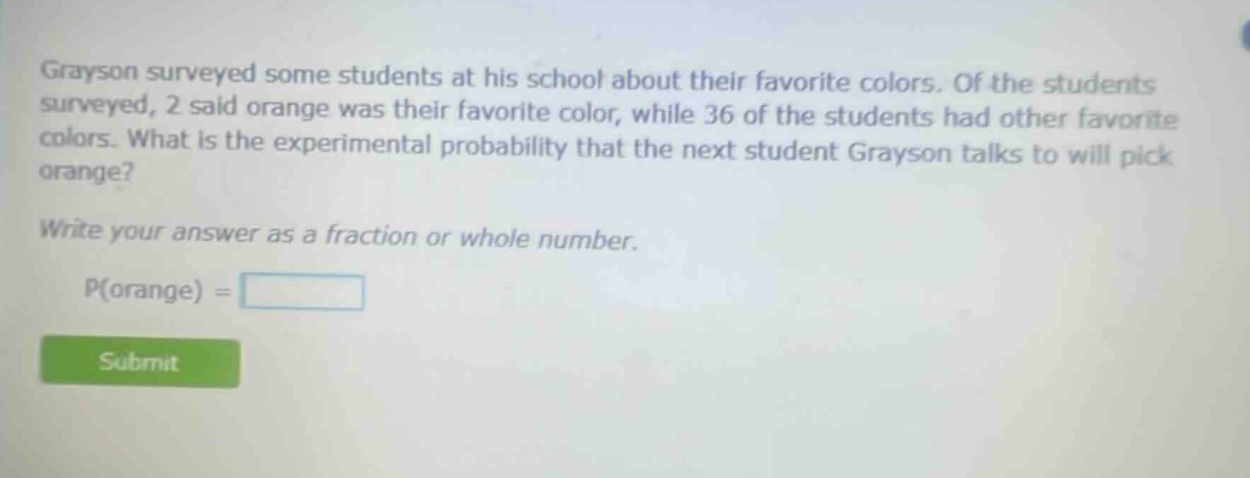
grayson surveyed some students at his school about their favorite colors. of the students surveyed, 2 said orange was their favorite color, while 36 of the students had other favorite colors. what is the experimental probability that the next student grayson talks to will pick orange? write your answer as a fraction or whole number. p(orange) =
Answer
Explanation:
Step1: Find total number of students surveyed
The total number of students surveyed is the sum of those who like orange and those who like other colors. So, $2 + 36=38$.
Step2: Calculate experimental - probability
The experimental probability $P(\text{orange})$ of a student picking orange is the number of students who like orange divided by the total number of students surveyed. So, $P(\text{orange})=\frac{2}{38}=\frac{1}{19}$.
Answer:
$\frac{1}{19}$