greg teaches an art class. the table below shows how many drawings his students had submitted by last…
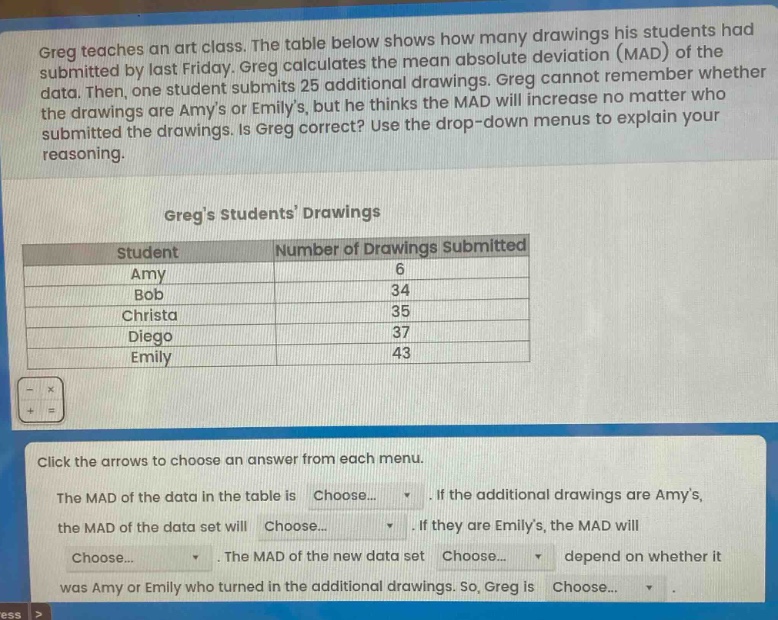
greg teaches an art class. the table below shows how many drawings his students had submitted by last friday. greg calculates the mean absolute deviation (mad) of the data. then, one student submits 25 additional drawings. greg cannot remember whether the drawings are amys or emilys, but he thinks the mad will increase no matter who submitted the drawings. is greg correct? use the drop - down menus to explain your reasoning.\n\ngregs students drawings\n| student | number of drawings submitted |\n| ---- | ---- |\n| amy | 6 |\n| bob | 34 |\n| christa | 35 |\n| diego | 37 |\n| emily | 43 |\n\nclick the arrows to choose an answer from each menu.\nthe mad of the data in the table is choose.... if the additional drawings are amys, the mad of the data set will choose.... if they are emilys, the mad will choose.... the mad of the new data set choose.... depend on whether it was amy or emily who turned in the additional drawings. so, greg is choose....
Answer
Answer:
- First - blank: Calculate the original MAD.
- Second - blank: Increase.
- Third - blank: Decrease.
- Fourth - blank: Yes.
- Fifth - blank: Incorrect.
Explanation:
Step1: Calculate the original mean
The original data set is (6,34,35,37,43). The mean (\bar{x}=\frac{6 + 34+35+37+43}{5}=\frac{155}{5}=31).
Step2: Calculate the original absolute - deviations
For (x_1 = 6), (|x_1-\bar{x}|=|6 - 31| = 25); for (x_2=34), (|x_2-\bar{x}|=|34 - 31| = 3); for (x_3 = 35), (|x_3-\bar{x}|=|35 - 31| = 4); for (x_4=37), (|x_4-\bar{x}|=|37 - 31| = 6); for (x_5 = 43), (|x_5-\bar{x}|=|43 - 31| = 12). The original MAD (=\frac{25+3+4+6+12}{5}=\frac{50}{5}=10).
Step3: Consider if the new data is Amy's
If the new data point is (6 + 25=31) (Amy's new value). The new mean of the data set ({31,34,35,37,43}) is (\bar{x}{new}=\frac{31+34+35+37+43}{5}=\frac{180}{5}=36). The absolute - deviations are: for (x_1 = 31), (|x_1-\bar{x}{new}|=|31 - 36| = 5); for (x_2=34), (|x_2-\bar{x}{new}|=|34 - 36| = 2); for (x_3 = 35), (|x_3-\bar{x}{new}|=|35 - 36| = 1); for (x_4=37), (|x_4-\bar{x}{new}|=|37 - 36| = 1); for (x_5 = 43), (|x_5-\bar{x}{new}|=|43 - 36| = 7). The new MAD (=\frac{5 + 2+1+1+7}{5}=\frac{16}{5}=3.2), which is an increase from the original MAD of (10).
Step4: Consider if the new data is Emily's
If the new data point is (43+25 = 68) (Emily's new value). The new mean of the data set ({6,34,35,37,68}) is (\bar{x}{new}=\frac{6+34+35+37+68}{5}=\frac{180}{5}=36). The absolute - deviations are: for (x_1 = 6), (|x_1-\bar{x}{new}|=|6 - 36| = 30); for (x_2=34), (|x_2-\bar{x}{new}|=|34 - 36| = 2); for (x_3 = 35), (|x_3-\bar{x}{new}|=|35 - 36| = 1); for (x_4=37), (|x_4-\bar{x}{new}|=|37 - 36| = 1); for (x_5 = 68), (|x_5-\bar{x}{new}|=|68 - 36| = 32). The new MAD (=\frac{30+2+1+1+32}{5}=\frac{66}{5}=13.2), which is a decrease from the original MAD of (10). So, Greg is incorrect.