a group of 150 students were asked whether they have a curfew and whether they have chores at home. their…
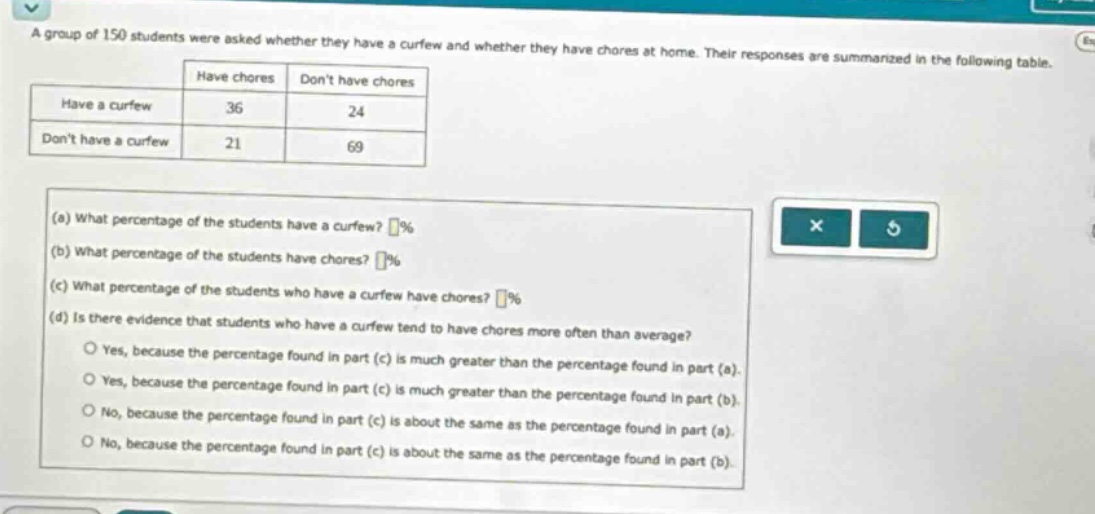
a group of 150 students were asked whether they have a curfew and whether they have chores at home. their responses are summarized in the following table.\n| |have chores|dont have chores|\n|--|--|--|\n|have a curfew|36|24|\n|dont have a curfew|21|69|\n(a) what percentage of the students have a curfew? %\n(b) what percentage of the students have chores? %\n(c) what percentage of the students who have a curfew have chores? %\n(d) is there evidence that students who have a curfew tend to have chores more often than average?\nyes, because the percentage found in part (c) is much greater than the percentage found in part (a).\nyes, because the percentage found in part (c) is much greater than the percentage found in part (b).\nno, because the percentage found in part (c) is about the same as the percentage found in part (a).\nno, because the percentage found in part (c) is about the same as the percentage found in part (b).
Answer
Explanation:
Step1: Calculate percentage of students with curfew
The number of students with curfew is (36 + 24=60). The total number of students is (150). The percentage formula is (\frac{\text{Number of students with curfew}}{\text{Total number of students}}\times100). So, (\frac{60}{150}\times 100 = 40).
Step2: Calculate percentage of students with chores
The number of students with chores is (36+21 = 57). Using the percentage formula (\frac{\text{Number of students with chores}}{\text{Total number of students}}\times100), we get (\frac{57}{150}\times100=38).
Step3: Calculate percentage of students with curfew who have chores
The number of students with curfew and chores is (36), and the number of students with curfew is (60). Using the percentage formula (\frac{\text{Number of students with curfew and chores}}{\text{Number of students with curfew}}\times100), we have (\frac{36}{60}\times 100 = 60).
Step4: Analyze the evidence
The percentage of students with curfew is (40%), the percentage of students with chores is (38%), and the percentage of students with curfew who have chores is (60%). Since (60%) (from part (c)) is much greater than (38%) (from part (b)), there is evidence that students who have a curfew tend to have chores more often than average.
Answer:
(a) (40) (b) (38) (c) (60) (d) Yes, because the percentage found in part (c) is much greater than the percentage found in part (b).