hal and jose are avid crossword - puzzle solvers. hal solves 48% of his crossword puzzles in under 30…
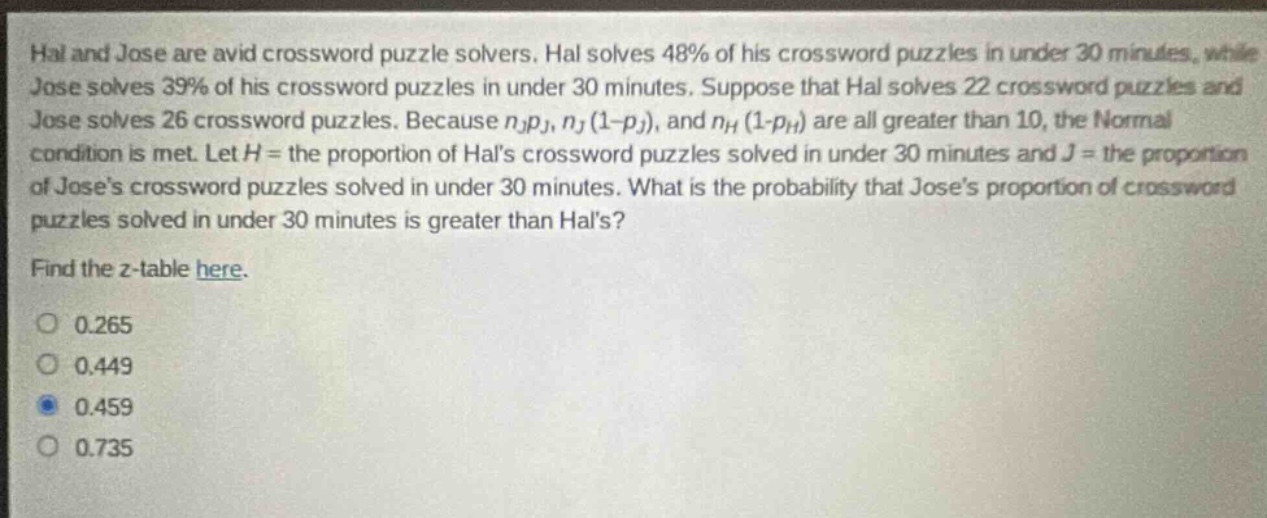
hal and jose are avid crossword - puzzle solvers. hal solves 48% of his crossword puzzles in under 30 minutes, while jose solves 39% of his crossword puzzles in under 30 minutes. suppose that hal solves 22 crossword puzzles and jose solves 26 crossword puzzles. because $n_jp_j$, $n_j(1 - p_j)$, and $n_h(1 - p_h)$ are all greater than 10, the normal condition is met. let $h$ = the proportion of hals crossword puzzles solved in under 30 minutes and $j$ = the proportion of joses crossword puzzles solved in under 30 minutes. what is the probability that joses proportion of crossword puzzles solved in under 30 minutes is greater than hals? find the z - table here. 0.265 0.449 0.459 0.735
Answer
Explanation:
Step1: Identify the given proportions and sample - sizes
Let $p_H = 0.48$ (Hal's proportion), $n_H=22$ (Hal's sample - size), $p_J = 0.39$ (Jose's proportion), $n_J = 26$ (Jose's sample - size). The mean of the sampling distribution of $\hat{p}_J-\hat{p}H$ is $\mu{\hat{p}_J-\hat{p}_H}=p_J - p_H=0.39 - 0.48=- 0.09$. The standard deviation of the sampling distribution of $\hat{p}_J-\hat{p}H$ is $\sigma{\hat{p}_J - \hat{p}H}=\sqrt{\frac{p_J(1 - p_J)}{n_J}+\frac{p_H(1 - p_H)}{n_H}}$. Substitute the values: [ \begin{align*} \sigma{\hat{p}_J - \hat{p}_H}&=\sqrt{\frac{0.39\times(1 - 0.39)}{26}+\frac{0.48\times(1 - 0.48)}{22}}\ &=\sqrt{\frac{0.39\times0.61}{26}+\frac{0.48\times0.52}{22}}\ &=\sqrt{\frac{0.2379}{26}+\frac{0.2496}{22}}\ &=\sqrt{0.00915 + 0.011345}\ &=\sqrt{0.020495}\approx0.1432 \end{align*} ]
Step2: Calculate the z - score
We want to find $P(\hat{p}_J>\hat{p}_H)$, which is equivalent to $P(\hat{p}_J-\hat{p}_H>0)$. The z - score is $z=\frac{(\hat{p}_J-\hat{p}H)-\mu{\hat{p}_J-\hat{p}H}}{\sigma{\hat{p}_J - \hat{p}_H}}$. Substitute $\hat{p}_J-\hat{p}H = 0$, $\mu{\hat{p}_J-\hat{p}H}=-0.09$ and $\sigma{\hat{p}_J - \hat{p}_H}\approx0.1432$ into the z - score formula: [z=\frac{0-(-0.09)}{0.1432}=\frac{0.09}{0.1432}\approx0.63]
Step3: Find the probability using the z - table
We want $P(Z > 0.63)$. Since the total area under the standard normal curve is 1, $P(Z>0.63)=1 - P(Z\leqslant0.63)$. From the z - table, $P(Z\leqslant0.63)=0.7357$. So $P(Z > 0.63)=1 - 0.7357 = 0.2643\approx0.265$.
Answer:
0.265