harris went to the store to compare prices of hiking shoes.\nshoe style a b c d e f\nprice ($) 125 110 95…
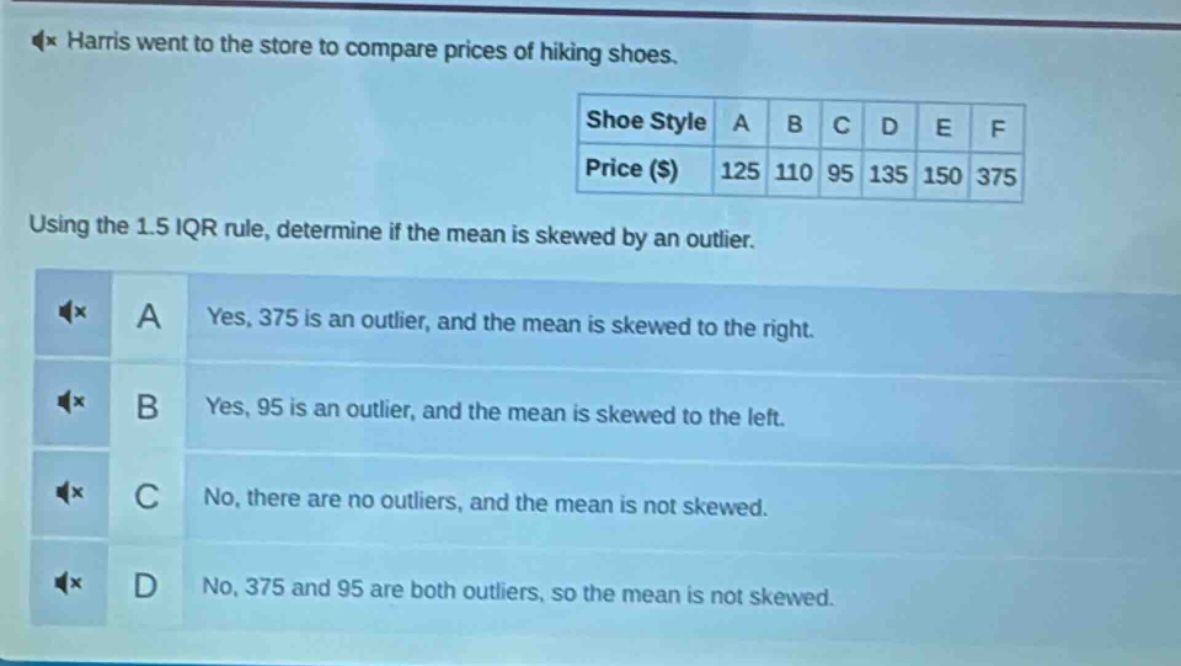
harris went to the store to compare prices of hiking shoes.\nshoe style a b c d e f\nprice ($) 125 110 95 135 150 375\nusing the 1.5 iqr rule, determine if the mean is skewed by an outlier.\na yes, 375 is an outlier, and the mean is skewed to the right.\nb yes, 95 is an outlier, and the mean is skewed to the left.\nc no, there are no outliers, and the mean is not skewed.\nd no, 375 and 95 are both outliers, so the mean is not skewed.
Answer
Answer:
A. Yes, 375 is an outlier, and the mean is skewed to the right.
Explanation:
Step1: Ordenar los datos
95, 110, 125, 135, 150, 375
Step2: Encontrar Q1 y Q3
La mediana de los datos es $\frac{125 + 135}{2}=130$. Los datos menores a la mediana son 95, 110, 125. Entonces Q1 = 110. Los datos mayores a la mediana son 135, 150, 375. Entonces Q3 = 150.
Step3: Calcular el rango inter - cuartil (IQR)
$IQR=Q3 - Q1=150 - 110 = 40$
Step4: Encontrar los límites para detectar outliers
Límite inferior: $Q1-1.5\times IQR=110-1.5\times40=110 - 60 = 50$ Límite superior: $Q3 + 1.5\times IQR=150+1.5\times40=150 + 60 = 210$
Step5: Identificar outliers
375 > 210, entonces 375 es un outlier. Un outlier grande hace que la media sea sesgada hacia la derecha.