harry goes to hogwarts school of witchcraft and wizardry. he can travel to school and back in 3 different…
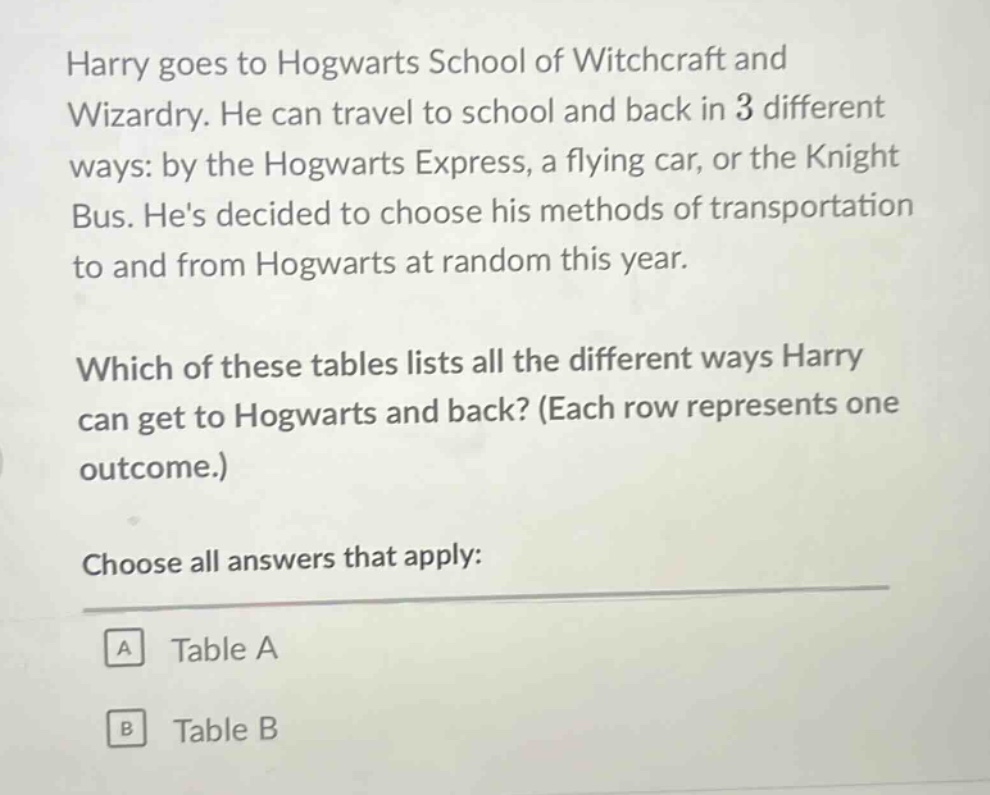
harry goes to hogwarts school of witchcraft and wizardry. he can travel to school and back in 3 different ways: by the hogwarts express, a flying car, or the knight bus. hes decided to choose his methods of transportation to and from hogwarts at random this year. which of these tables lists all the different ways harry can get to hogwarts and back? (each row represents one outcome.) choose all answers that apply: a table a b table b
Answer
Explanation:
Step1: List possible combinations
Let the three methods be (H) (Hogwarts Express), (F) (flying - car), and (K) (Knight Bus). The possible ways to go to school and back are: ((H,H)), ((H,F)), ((H,K)), ((F,H)), ((F,F)), ((F,K)), ((K,H)), ((K,F)), ((K,K)).
Step2: Check tables
We need to check Table A and Table B to see which one(s) list all these combinations. Without seeing the actual tables, we assume that we will identify the tables that have all 9 possible pairs.
Since we don't have the content of Table A and Table B, we can't give a definite final - answer. But the general way to solve this problem is as above. If we assume that Table A and Table B are presented and we check them one by one:
- For each pair in the list ((H,H)), ((H,F)), ((H,K)), ((F,H)), ((F,F)), ((F,K)), ((K,H)), ((K,F)), ((K,K)), we see if it is in the table.
- If a table has all 9 pairs, it is a correct answer.
If we had the tables:
- We would go through each row of Table A and Table B and check if all the 9 possible pairs are present.
- If Table A has all 9 pairs, then A is a correct answer. If Table B has all 9 pairs, then B is a correct answer.
Since the tables are not provided, we can't give a specific answer. But the process to find the answer is as described above.
If we assume that after checking the tables:
Answer:
If Table A has all 9 combinations: A. Table A If Table B has all 9 combinations: B. Table B If both have all 9 combinations: A. Table A, B. Table B If neither has all 9 combinations: None of the above (not given as an option in the problem - statement but for completeness)