a health instructor surveyed all her students, and tallied the results. the first survey question asked, \do…
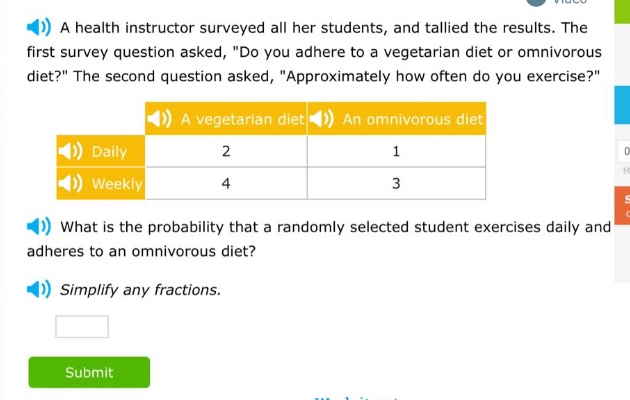
a health instructor surveyed all her students, and tallied the results. the first survey question asked, \do you adhere to a vegetarian diet or omnivorous diet?\ the second question asked, \approximately how often do you exercise?\ what is the probability that a randomly selected student exercises daily and adheres to an omnivorous diet? simplify any fractions.
Answer
Explanation:
Step1: Calculate total number of students
Add up all the values in the table: $2 + 1+4 + 3=10$.
Step2: Identify number of students who exercise daily and are omnivorous
From the table, the number of students who exercise daily and adhere to an omnivorous diet is 1.
Step3: Calculate the probability
The probability $P$ is the number of favorable outcomes divided by the total number of outcomes. So $P=\frac{1}{10}$.
Answer:
$\frac{1}{10}$