the heights of the trees in a forest are normally distributed, with a mean of 25 meters and a standard…
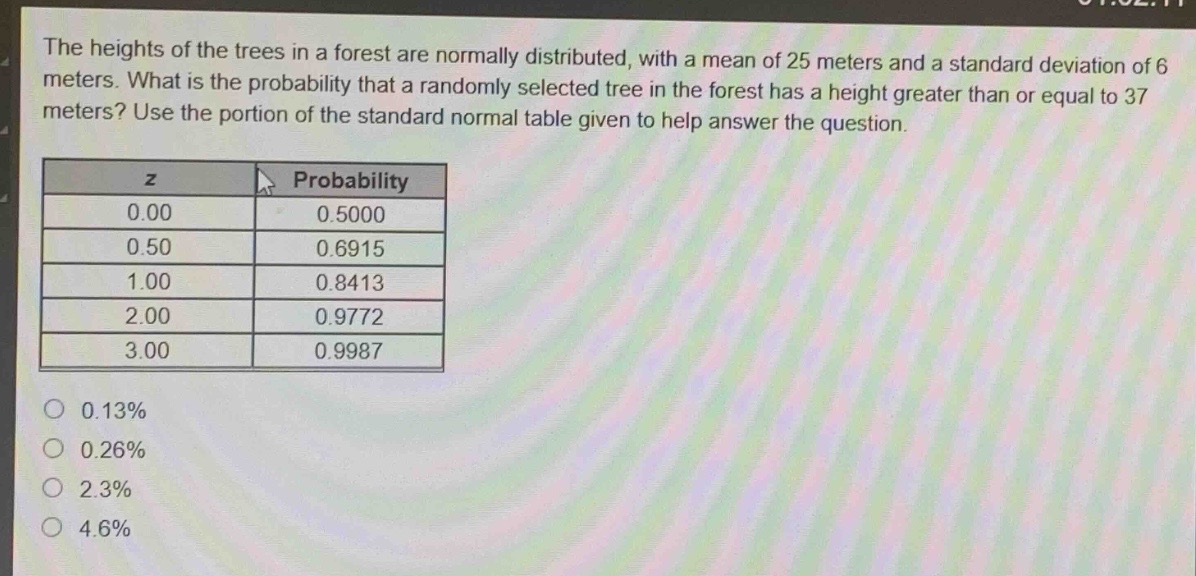
the heights of the trees in a forest are normally distributed, with a mean of 25 meters and a standard deviation of 6 meters. what is the probability that a randomly selected tree in the forest has a height greater than or equal to 37 meters? use the portion of the standard normal table given to help answer the question.\n| z | probability |\n| ---- | ---- |\n| 0.00 | 0.5000 |\n| 0.50 | 0.6915 |\n| 1.00 | 0.8413 |\n| 2.00 | 0.9772 |\n| 3.00 | 0.9987 |\n0.13%\n0.26%\n2.3%\n4.6%
Answer
Explanation:
Step1: Calculate the z - score
The formula for the z - score is $z=\frac{x-\mu}{\sigma}$, where $x = 37$ (the value we are interested in), $\mu = 25$ (the mean), and $\sigma = 6$ (the standard deviation). So, $z=\frac{37 - 25}{6}=\frac{12}{6}=2$.
Step2: Find the probability from the standard - normal table
The standard - normal table gives the cumulative probability $P(Z\leq z)$. We found $z = 2$ and from the table $P(Z\leq2)=0.9772$.
Step3: Calculate the probability of $P(Z\geq2)$
Since the total area under the normal curve is 1, $P(Z\geq z)=1 - P(Z\leq z)$. So, $P(Z\geq2)=1 - 0.9772 = 0.0228$.
Step4: Convert the probability to a percentage
To convert the probability to a percentage, we multiply by 100. So, $0.0228\times100 = 2.28%\approx2.3%$.
Answer:
2.3%