on her various camping trips, tiana kept a log of the types of snakes she saw. she noted their colors and…
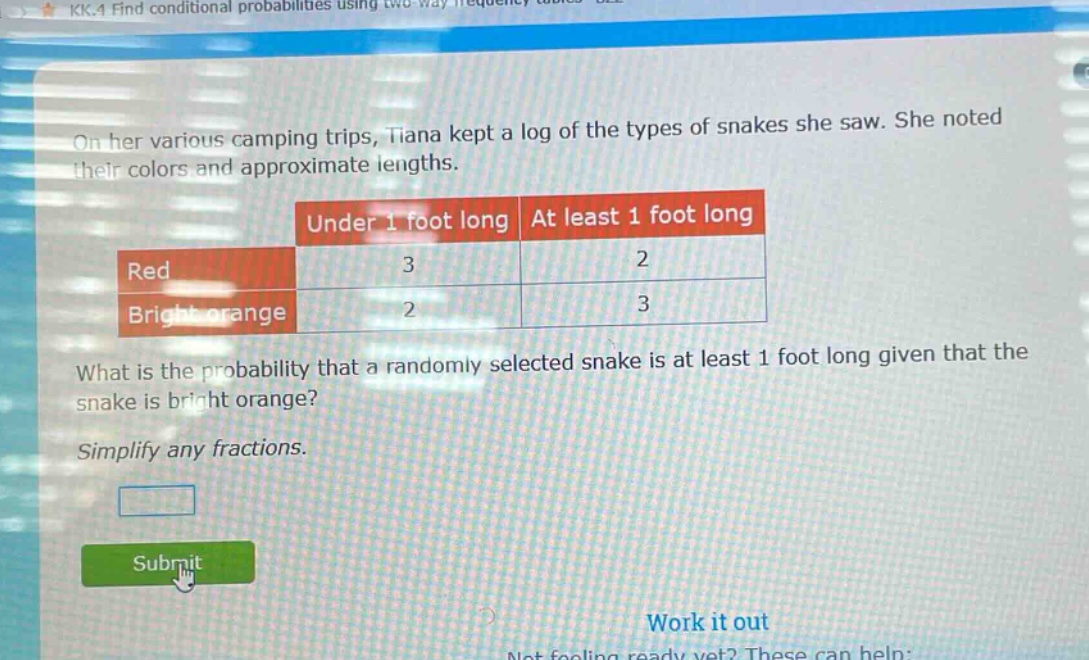
on her various camping trips, tiana kept a log of the types of snakes she saw. she noted their colors and approximate lengths.\n| |under 1 foot long|at least 1 foot long|\n|--|--|--|\n|red|3|2|\n|bright orange|2|3|\nwhat is the probability that a randomly selected snake is at least 1 foot long given that the snake is bright orange?\nsimplify any fractions.
Answer
Explanation:
Step1: Recall conditional - probability formula
The formula for conditional probability is $P(A|B)=\frac{P(A\cap B)}{P(B)}$. In terms of frequencies in a two - way table, if $A$ is the event that the snake is at least 1 foot long and $B$ is the event that the snake is bright orange, then $P(A|B)=\frac{n(A\cap B)}{n(B)}$, where $n(A\cap B)$ is the number of elements in the intersection of $A$ and $B$, and $n(B)$ is the number of elements in $B$.
Step2: Identify relevant frequencies
The number of bright - orange snakes that are at least 1 foot long ($n(A\cap B)$) is 3. The total number of bright - orange snakes ($n(B)$) is $2 + 3=5$.
Step3: Calculate the conditional probability
$P(A|B)=\frac{3}{5}$
Answer:
$\frac{3}{5}$