8. higher order thinking greg has a bag that contains 25 colored tiles. of all the tiles in the bag, 10 are…
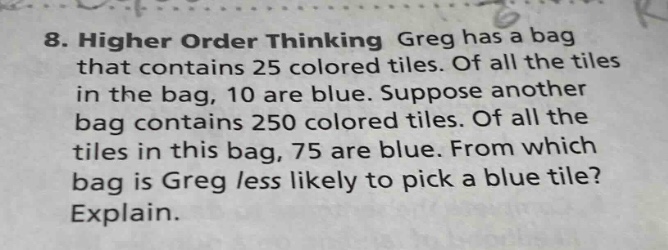
8. higher order thinking greg has a bag that contains 25 colored tiles. of all the tiles in the bag, 10 are blue. suppose another bag contains 250 colored tiles. of all the tiles in this bag, 75 are blue. from which bag is greg less likely to pick a blue tile? explain.
Answer
Explanation:
Step1: Calculate probability for first bag
The probability $P_1$ of picking a blue - tile from the first bag is the number of blue tiles divided by the total number of tiles. The first bag has 10 blue tiles out of 25 total tiles. So, $P_1=\frac{10}{25}=\frac{2}{5}=0.4$.
Step2: Calculate probability for second bag
The probability $P_2$ of picking a blue - tile from the second bag is the number of blue tiles divided by the total number of tiles. The second bag has 75 blue tiles out of 250 total tiles. So, $P_2=\frac{75}{250}=\frac{3}{10}=0.3$.
Step3: Compare probabilities
Since $0.3<0.4$, $P_2 < P_1$.
Answer:
Greg is less likely to pick a blue tile from the bag with 250 colored tiles because the probability of picking a blue tile from the bag with 250 tiles ($0.3$) is less than the probability of picking a blue tile from the bag with 25 tiles ($0.4$).