hiro has a stack of cards with one number from the set 1, 1, 2, 2, 3, 3, 3, 4 written on each card. what is…
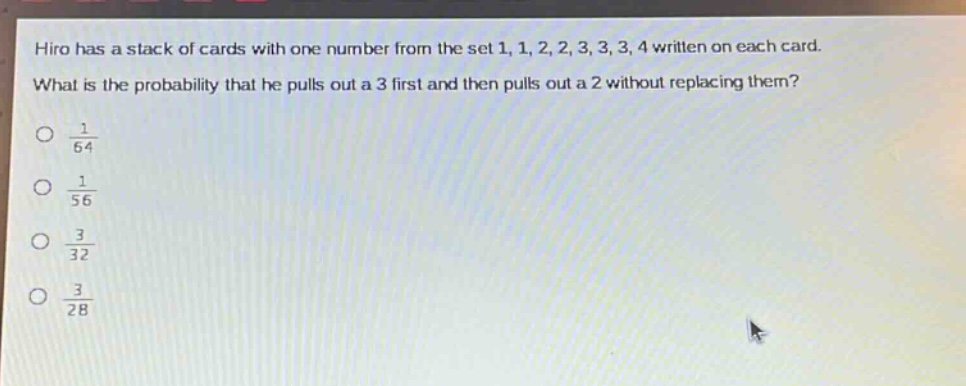
hiro has a stack of cards with one number from the set 1, 1, 2, 2, 3, 3, 3, 4 written on each card. what is the probability that he pulls out a 3 first and then pulls out a 2 without replacing them?\n$\frac{1}{64}$\n$\frac{1}{56}$\n$\frac{3}{32}$\n$\frac{3}{28}$
Answer
Explanation:
Step1: Calculate total number of cards
There are 2 cards with number 1, 2 cards with number 2, 3 cards with number 3 and 1 card with number 4. So the total number of cards is $2 + 2+3 + 1=8$.
Step2: Calculate probability of pulling a 3 first
The probability of pulling a 3 first is the number of 3 - cards divided by the total number of cards. There are 3 cards with number 3, so the probability $P_1=\frac{3}{8}$.
Step3: Calculate probability of pulling a 2 second (without replacement)
After pulling a 3 first, there are now 7 cards left. There are 2 cards with number 2, so the probability $P_2=\frac{2}{7}$.
Step4: Calculate the combined probability
The probability of both events happening is the product of their individual probabilities. So $P = P_1\times P_2=\frac{3}{8}\times\frac{2}{7}=\frac{6}{56}=\frac{3}{28}$.
Answer:
$\frac{3}{28}$