identify the level of measurement of the data, and explain what is wrong with the given calculation. in a…
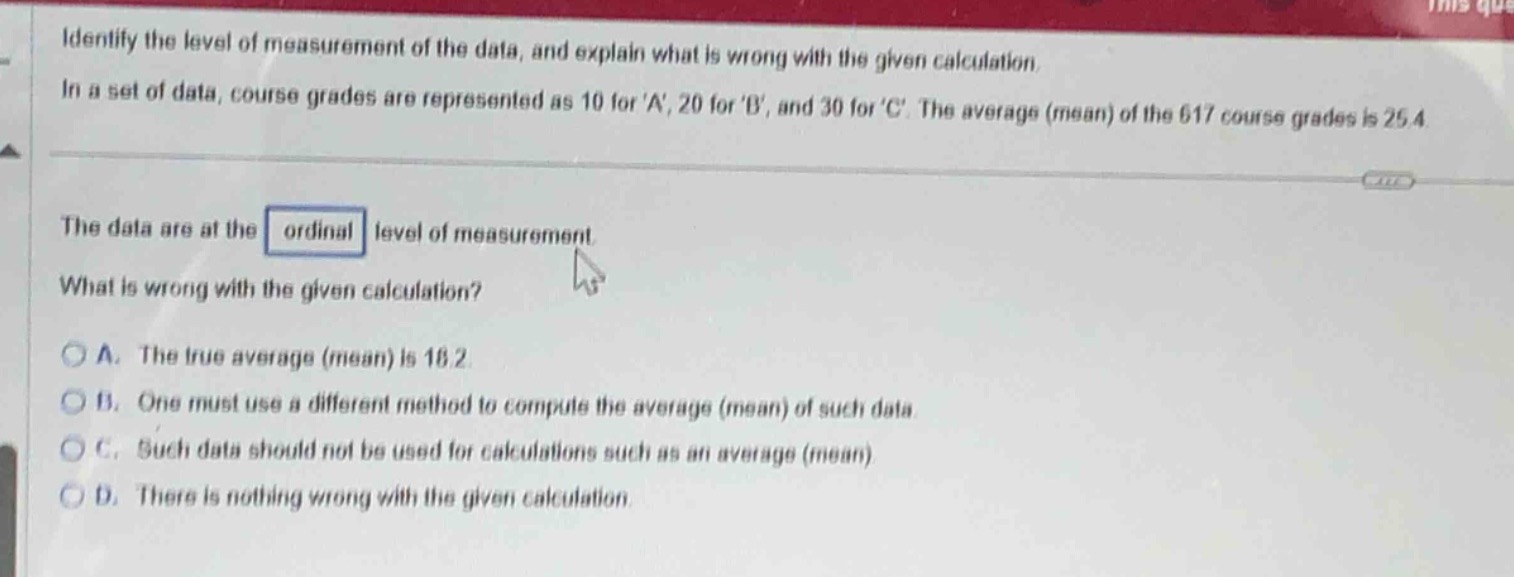
identify the level of measurement of the data, and explain what is wrong with the given calculation. in a set of data, course grades are represented as 10 for a, 20 for b, and 30 for c. the average (mean) of the 617 course grades is 25.4. the data are at the ordinal level of measurement. what is wrong with the given calculation? a. the true average (mean) is 18.2. b. one must use a different method to compute the average (mean) of such data. c. such data should not be used for calculations such as an average (mean). d. there is nothing wrong with the given calculation.
Answer
Answer:
C. Such data should not be used for calculations such as an average (mean)
Explanation:
Step1: Understand ordinal data
Ordinal data has an order, but differences between values are not meaningful.
Step2: Analyze grade - value assignment
Course grades 'A', 'B', 'C' are ordinal. The assigned numbers (10, 20, 30) are arbitrary rankings, not actual numerical values for arithmetic operations.
Step3: Determine issue with mean calculation
Calculating the mean of such ordinal - coded data is inappropriate as the numbers don't represent true magnitudes.