identify the type i error and the type ii error that correspond to the given hypothesis. the percentage of…
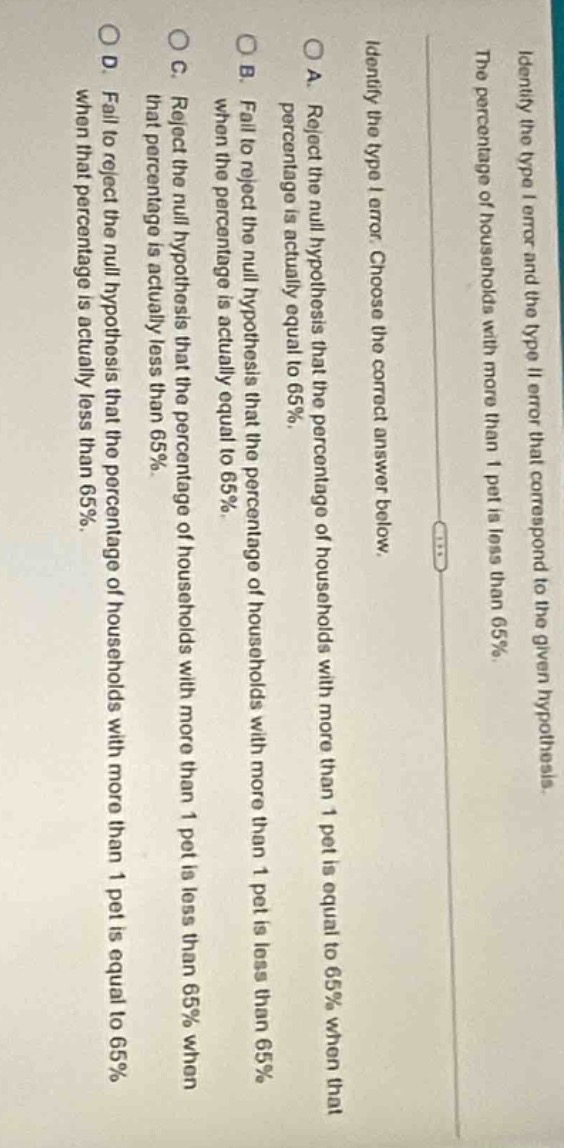
identify the type i error and the type ii error that correspond to the given hypothesis. the percentage of households with more than 1 pet is less than 65%. identify the type i error. choose the correct answer below. a. reject the null hypothesis that the percentage of households with more than 1 pet is equal to 65% when that percentage is actually equal to 65%. b. fail to reject the null hypothesis that the percentage of households with more than 1 pet is equal to 65% when the percentage is actually less than 65%. c. reject the null hypothesis that the percentage of households with more than 1 pet is less than 65% when that percentage is actually less than 65%. d. fail to reject the null hypothesis that the percentage of households with more than 1 pet is equal to 65% when that percentage is actually less than 65%.
Answer
Brief Explanations:
A Type - I error occurs when the null hypothesis is true and we reject it. Here, the null hypothesis is that the percentage of households with more than 1 pet is equal to 65%. Rejecting this null hypothesis when it is actually true is a Type - I error.
Answer:
A. Reject the null hypothesis that the percentage of households with more than 1 pet is equal to 65% when the percentage is actually equal to 65%.